
First Reading: Exodus 14:19-31
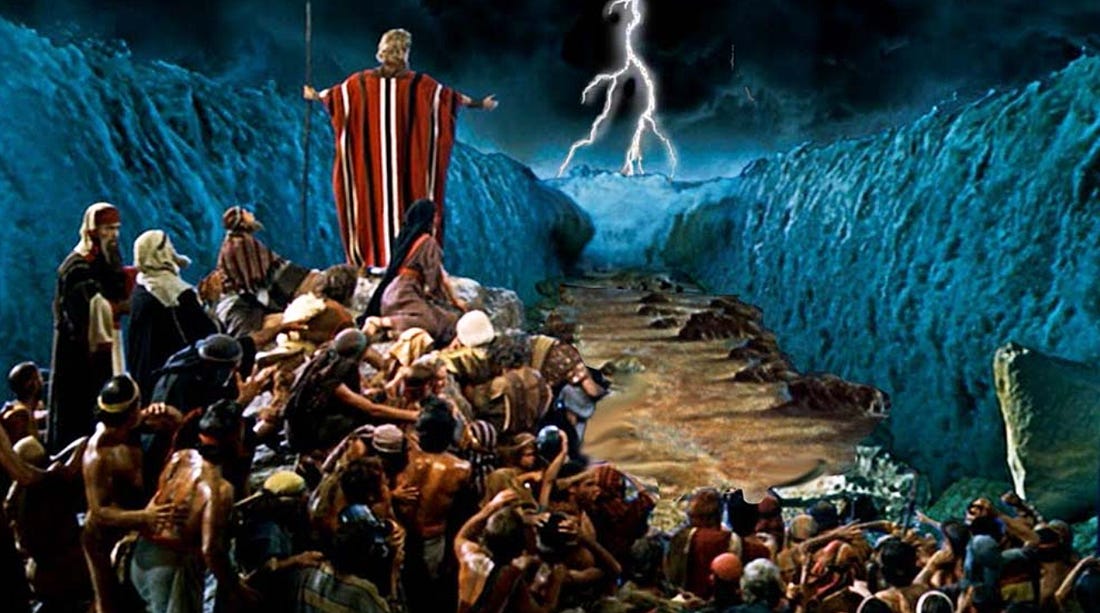
The angel of God who was going before the Israelite army moved and went behind them; and the pillar of cloud moved from in front of them and took its place behind them. It came between the army of Egypt and the army of Israel. And so the cloud was there with the darkness, and it lit up the night; one did not come near the other all night.Then Moses stretched out his hand over the sea. The Lord drove the sea back by a strong east wind all night, and turned the sea into dry land; and the waters were divided. The Israelites went into the sea on dry ground, the waters forming a wall for them on their right and on their left. The Egyptians pursued, and went into the sea after them, all of Pharaoh’s horses, chariots, and chariot drivers. At the morning watch the Lord in the pillar of fire and cloud looked down upon the Egyptian army, and threw the Egyptian army into panic. He clogged their chariot wheels so that they turned with difficulty. The Egyptians said, “Let us flee from the Israelites, for the Lord is fighting for them against Egypt.”Then the Lord said to Moses, “Stretch out your hand over the sea, so that the water may come back upon the Egyptians, upon their chariots and chariot drivers.” So Moses stretched out his hand over the sea, and at dawn the sea returned to its normal depth. As the Egyptians fled before it, the Lord tossed the Egyptians into the sea. The waters returned and covered the chariots and the chariot drivers, the entire army of Pharaoh that had followed them into the sea; not one of them remained. But the Israelites walked on dry ground through the sea, the waters forming a wall for them on their right and on their left.Thus the Lord saved Israel that day from the Egyptians; and Israel saw the Egyptians dead on the seashore. Israel saw the great work that the Lord did against the Egyptians. So the people feared the Lord and believed in the Lord and in his servant Moses.Second Reading: Matthew 18:21-35Peter came and said to Jesus, “Lord, if another member of the church sins against me, how often should I forgive? As many as seven times?” Jesus said to him, “Not seven times, but, I tell you, seventy-seven times.“For this reason the kingdom of heaven may be compared to a king who wished to settle accounts with his slaves. When he began the reckoning, one who owed him ten thousand talents was brought to him; and, as he could not pay, his lord ordered him to be sold, together with his wife and children and all his possessions, and payment to be made. So the slave fell on his knees before him, saying, ‘Have patience with me, and I will pay you everything.’ And out of pity for him, the lord of that slave released him and forgave him the debt. But that same slave, as he went out, came upon one of his fellow slaves who owed him a hundred denarii; and seizing him by the throat, he said, ‘Pay what you owe.’ Then his fellow slave fell down and pleaded with him, ‘Have patience with me, and I will pay you.’ But he refused; then he went and threw him into prison until he would pay the debt. When his fellow slaves saw what had happened, they were greatly distressed, and they went and reported to their lord all that had taken place. Then his lord summoned him and said to him, ‘You wicked slave! I forgave you all that debt because you pleaded with me. Should you not have had mercy on your fellow slave, as I had mercy on you?’ And in anger his lord handed him over to be tortured until he would pay his entire debt. So my heavenly Father will also do to every one of you, if you do not forgive your brother or sister from your heart.”Scripture ReflectionOur two readings today might seem very different, but they are actually very closely related. In the Exodus tale, Israel is the slave freed by the hand of the Lord from bondage to Egypt; in Jesus’ parable, the freed slave has turned back to the bondage of Egypt in his heart, oppressing others mercilessly in spite of receiving mercy. It is Jesus’ warning to Israel that they were “turning Egyptian”, so to speak. Indeed, his disciple John would come to call Jerusalem “Egypt” because the Lord was mercilessly crucified there (Rev. 11:8). The irony in Jesus’ parable was very relevant and edgy at the time. In warning Israel, Jesus is also giving a relevant and edgy warning the whole Church, the Israel of God (Gal. 6:16). And the warning is this: we must forgive one another from the heart. This is really the heart of the Great Commission: “in [Jesus’] name repentance and forgiveness of sins will be proclaimed to all nations, beginning in Jerusalem.” Forgiveness times seventy seven and more. Sometimes the church overcomplicates this. On the one hand, some people might emphasize sins over forgiveness, and get far too aggressive in nitpicking sins and over-diagnosing sinful behaviors, breeding scrupulosity, guilt, and shame. It’s like forgiveness times seventy-seven has been forgotten entirely in the effort to identify which sins are the most offensive vs are inoffensive enough to warrant a very limited supply of forgiveness. It suggests a blanket pardon for little sins that we don’t really need to worry about, and the threat of fire and brimstone for the bigger sins that we really don’t like. On the other hand, some people might emphasize forgiveness over sins, getting squeamish about our own sinfulness and preferring ideological workarounds [like social justice and liberation theology] where we can “confront” rather than forgive sin in what we call its “systemic” form, which is a bit less human, more anonymous and compartmentalized. Speaking truth to power is all well and good, but talk is often cheap, and at any rate, it’s not the forgiveness we’re commissioned to proclaim. This type of thinking is less about forgiving and more about building the perfect system that grants another type of blanket pardon. This type of approach, which is really fascinating, is about dehumanizing and relativizing what sin is in order to eliminate it as an absolute category of human experience, in hopes we can build a society where sin as a concept doesn’t exist anymore because everyone agrees that nothing is sinful. But is everyone really ever going to agree? And so not everyone ends up getting this type of “pardon”. Both of these approaches are equally at work in our society, not just in the church, and not exclusive to any particular ideology. You see bits and pieces of these atomizing and relativizing forces at work here, there and everywhere. It can all get rather systematic and legalistic, confusing if not contradictory, even hypocritical. But I think once we’re in this territory, we’ve wandered a bit astray from the matter of forgiving our brothers and sisters from the heart. Because forgiveness is always unique, we really can’t simply offer one blanket pardon of sins; every wrong done to you, to your face, is another fresh new challenge to your heart. Jesus didn’t say forgive “once and for all,” but “seventy-seven times,” and more. This is an ongoing lifestyle of mercy that anticipates an ongoing string of offenses being done to us. I do believe we’ve heard Jesus warn us that following him brings with it a certain amount of heat — friction with, and grief from, the world around us. We can certainly try to be more tolerant, less easily offended by all this. But that’s not really what Jesus was saying; he was saying, whenever someone offends you, forgive them. Every time it happens — and it will happen, over and over again. Seventy-seven times seven times etc. It’s important that our hearts stay soft enough to pull this off. Pharaoh chased Israel into the Red Sea because his heart was hardened, and Egypt drowned because it couldn’t stand to see Israel free. The New Testament says in a few places that this Red Sea imagery in Exodus is like baptism: but only Israel was baptized into Moses, while Egypt was faithless and hardhearted, and drowned in the same waters that baptized Israel. The lesson here is that if we would be baptized into Christ, into forgiveness, we need to be softhearted and faithful. Well, faithfulness implies consistency, sticking with it in the face of trials and challenges. Being diligently forgiving in the face of a string of offenses which might otherwise harden our hearts. And very interestingly, as much as we associate the waters of baptism with the gift of forgiveness, Jesus taught rather provocatively that we might only hope to truly receive the gift of forgiveness when we give it: “forgive us our trespasses as we forgive those who trespass against us”. In Jesus’ parable, the one at first forgiven refused to forgive, and so he was not forgiven at all. That’s the Our Father prayer in action — forgive us as we forgive others. This might be the real lesson in the image of the “Red Sea baptism”. Israel passed through these waters prepared to faithfully pay forward what God gifted them; Egypt didn’t. Only one made it out alive. So if we would truly live, we would be faithful, and diligent in the Great Commission: proclaiming forgiveness of sins to all nations and people, paying it forward. We can even synthesize the two approaches to sin and forgiveness that we discussed earlier: we can learn to discern what sin is, what truly causes offense to the human person, diagnosing it without being squeamish about it or dehumanizing it and projecting it onto an abstract “system”, and we can therefore actually begin to take personal responsibility for it (that is, forgive it); on the other hand, we can also soften our hearts so that, if we can’t become as thick-skinned and “unoffendable” as we would like, we can at least become as forgiving as Jesus commands us to be. We neither need to overemphasize or underemphasize sin to deal with it; we are simply commanded to forgive it — not once, not seven times, but seventy-seven times and more, such is the volume of offenses Jesus told us to expect from the world. And forgiveness is truly everything because it’s really what salvation is all about. Peter wrote that the sacrament of forgiveness, “baptism now saves you,” but he is keen to point out that he’s not talking about water, rather he’s talking about the pledge of a clear conscience — that is, being a “freed slave” who sets others free, blameless in the sight of the one who set us free for that purpose! How’s that for a “clear conscience”? We do often think that avoiding sin is the path to a clear conscience. But the Bible says, hey, if we sin, we have an advocate in the Lord; don’t sweat your own sin all too much is the message here, believe it or not. We shouldn’t imagine that our conscience can be made clean by not sinning. That’s just never going to happen, no one is without sin. That’s why Jesus advocates for us. But we can have a clean conscience if we honor our advocate by forgiving others as he forgives them. By ourselves becoming advocates and forgivers like him. Forgiving as we are forgiven, baptizing so to speak as we are baptized, with clear conscience. I know we don’t like to talk about sin, but if we don’t, it undersells forgiveness and mercy, and then we lose track of what salvation is. I think that’s why we sometimes get distracted by convoluted grand plans for salvation, that is, our politics — because we think the whole “forgiveness of sins” thing in Christianity is just about saving individuals, and that makes us squeamish about ourselves. It follows from this individualist view that we also assume that this offer of salvation is somehow not applicable to society as a whole, so we have to cobble up some grand political scheme to account for that glaring omission! It’s why politics can get so downright cultlike, because it’s trying to solve spiritual problems, and inevitably becomes sort of religious. I mean, we all know the world is messed up; the Bible simply uses the word “Sinful” instead of “messed up”. Humanity doesn’t really have an answer to the problem of “messed up,” but the Holy Spirit has certainly revealed to us that there is salvation for all sinners: it’s forgiveness. The scope of salvation that the New Testament teaches about is not just individual, but cosmically social and socially cosmic, and it’s all bundled up with the gift of forgiveness. We don’t need all these additional systems of social salvation that have yet to ever be fruitful anyway; we just need to have hearts that are forgiving towards our brothers and sisters in the human family. The prophet-priest Zechariah called the forgiveness of sins “the knowledge of salvation” (Lk. for all God’s people. Forgiveness isn’t just about saving individuals; it saves all nations and people. It is the saving social justice, or better yet, social mercy, for which we truly hunger and thirst, and it is the secret to peace. Scandalously simple really, hidden from the wise and learned, but revealed to little babes. We have to have faith like little children to enter the Kingdom of God, baptized into Christ’s forgiveness, lest we drown in these waters like Egypt, falling short of “seventy seven times seventy seven” as the sublime demands of the path of forgiveness overwhelm us. Let’s avoid the temptations of hardhearted, misguided schemes of salvation for the world when all the Holy Spirit teaches on the matter boils down to simple, softhearted forgiveness. It is a simple thing in which to be diligent, in which to be faithful; and if we can be consistent about it, forgiving from the heart as we have been forgiven by the soft heart of God, we can truly say that we have been saved.
Song Meditation: “Love Thy Neighbor”
(“Love Thy Neighbor” lyric t-shirt available here) “Small Town Incorporated” Out Now On Vinyl!
Song RequestsI’ll send you a personalized recording of your song request. Drop the song name in as a note along with your e-mail! Upcoming Appearances:
You're currently a free subscriber to Seán McMahon. For the full experience, upgrade your subscription.
|







No comments:
Post a Comment