
You Are What You EatWe are what we eat: the dead eat the fruit of death, the word of judgment, and the living eat the fruit of eternal life, the word of grace.
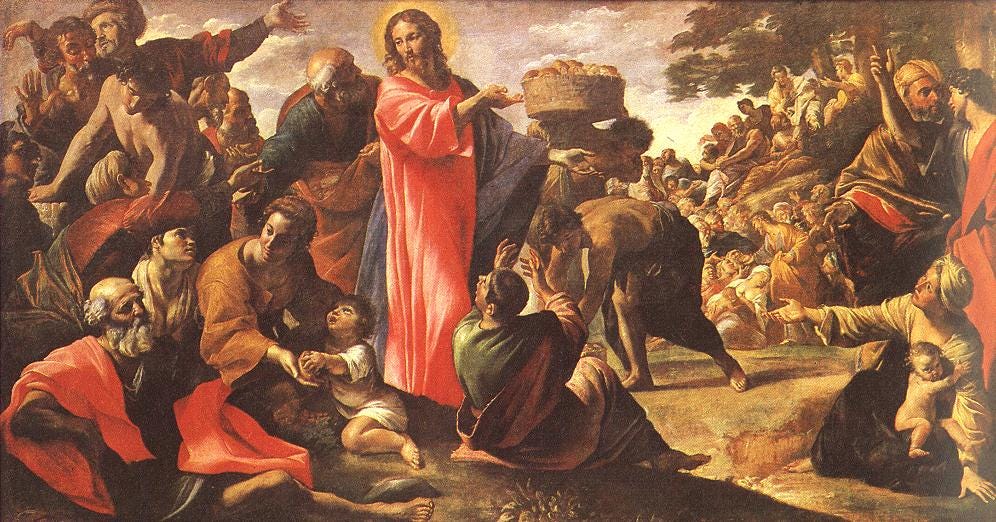
Scripture ReadingMatthew 14:13-21Jesus withdrew in a boat to a deserted place by himself. But when the crowds heard it, they followed him on foot from the towns. When he went ashore, he saw a great crowd; and he had compassion for them and cured their sick. When it was evening, the disciples came to him and said, “This is a deserted place, and the hour is now late; send the crowds away so that they may go into the villages and buy food for themselves.” Jesus said to them, “They need not go away; you give them something to eat.” They replied, “We have nothing here but five loaves and two fish.” And he said, “Bring them here to me.” Then he ordered the crowds to sit down on the grass. Taking the five loaves and the two fish, he looked up to heaven, and blessed and broke the loaves, and gave them to the disciples, and the disciples gave them to the crowds. And all ate and were filled; and they took up what was left over of the broken pieces, twelve baskets full. And those who ate were about five thousand men, besides women and children.Scripture ReflectionThe miracle of the loaves and fishes, which satiated the hunger of five thousand people for one brief moment, pales in comparison to the miracle of the Word of God, which satiates the true hunger of all God’s people eternally. The Word of God is the heavenly bread which has descended from heaven, offered to us and through us in the Body of Christ. The Word of God shall never pass away (Mt. 24:35); as the bread of God, no matter how many times it is broken and offered to the hungry, it never becomes scarce. The bread of the Word is ever multiplying, no matter how much it is consumed. Founded upon and embodying the Word, the Church is almost like a divine multi-level marketing scheme: recruitment, or evangelism, is the product. The Gospel-Word we are commissioned to preach perpetuates the Great Commission itself: “Go into all the world and preach the Gospel to every creature…in [Jesus’] name repentance and forgiveness of sins will be proclaimed to all nations.” (Mk. 16:15; Lk. 24:47). We advertise and offer training in God’s forgiveness, and commission those who believe to advertise and offer training in it as well. Here, demand does not drive down and deplete supply; supply raises up and inspires demand. The more the Word is preached, the more it is loved, the higher it is in demand. It cannot be demanded unless it is first supplied: “How, then, can they call on the one they have not believed in?” — that is, the Word of God, Jesus — “And how can they believe in the one of whom they have not heard?” — that is, again, the Word — “And how can they hear without someone preaching to them?” (Ro. 10:14). The heart of the demand for the Word is the heart of man himself. The hidden desire of all men’s hearts is the Word of God because the Word is the good, and makes the good. How is this so if “only God is good”? (Mk. 10:18). Because “in the beginning was the Word, and the word was with God, and the Word was God.” (Jn. 1:1). God is good; his Word is good, because he is God. By his Word, God brought all things into being (Heb. 11:3), and planted a Garden full of fertile — that is, multiplying — seed-bearing plants and seed-bearing fruit for man’s feasting. All of these, according to the Word of God, were good, and good for food. See how the only-good God endowed his creation with his own goodness through his Word! Yet Eve set her heart on the one forbidden fruit, desiring it not because the Word said it was good for food, beautiful to the eyes, or desirous to make one wise (Gen. 3:6) — because the Word did not tell her this — but because she believed that the forbidden fruit had all these qualities in itself. She was wrong. Mankind has been living for “the god in their bellies” (Php. 3:19) ever since, and our sensual pursuits have come under the domination of the archons of other bodily organs as well. We so often believe that the “good” may be found in so many things, as if they are good unto themselves, and we desire them more than the Word which declares what is truly good. Nonetheless, though we misplace the good for which we hunger in the creation, our disordered sense of what is good does not change the fact that in our hearts, it is always the true good for which we hunger — and that good is our Creator, the Word of God. The Messianic Feast of the Word of God Incarnate, Christ, to which we are invited is so much more miraculous than the miracle of the loaves and fishes because it is the return to and redemption of Eden, where now everything is good for food. For by the forbidden fruit of the Tree of the Knowledge of Good and Evil — that is, death — Christ conquered death and opened the way to the Tree of Eternal Life which had been barred from us. In the divine wisdom of scripture, “food” is so much more than food. St. Peter saw a vision of the Messianic Feast, and was told to rise, kill, and eat all types of beasts which had until then been unlawful food for a Jew to eat (Acts 10:9f); not only did this divine vision show that he was released from these laws against food, but the beasts represented all of the people who had previously been barred from Divine Communion by the Law as a whole. Since then, “everything is lawful for me,” says Paul, “but not everything is beneficial.” (1 Cor. 6:12). Our freedom is not a license for gluttony or any other form of disordered sensuality. For “the kingdom of God is not a matter of eating and drinking, but of virtue, peace and joy in the Holy Spirit.” (Ro. 14:17). This is why Jesus pointed past the loaves and fishes to his Word, and Paul pointed past the bread and wine to the body and blood of the Lord, who “is the Spirit” (2 Cor. 3:17). Those who love and eat the Word are his spiritual Body, whose lifeblood is the Spirit. We are what we eat: the dead eat the fruit of death, the word of judgment, and the living eat the fruit of eternal life, the word of grace. For the Word is Spirit and life (Jn. 6:63). The Word of God, Christ Jesus, is the Truth which sets us free from all bondage, even to death, for he “has destroyed death and has brought life and immortality to light through the gospel.” (2 Tim. 1:10). “Food freedom” might seem a small thing beside freedom from death — but on a spiritual level, freedom from death is exactly what “food freedom” is: since we have a food, the Word of God, that sustains us to eternal life, there is no “forbidden fruit” that can truly bring death upon us. The Paschal mystery has revealed that death, in fact, is the means by which we are born into eternal life. Like the other fruits of Eden, the fruit of the tree of death was seed-bearing, and by God’s gracious provision in his economy of salvation, that seed is Christ the Word of God incarnate; he fell to the ground, died, and out of his death came the fruit of eternal life for all. This is the truth which sets us free. If we are now so liberated to “eat” all things, then, we can only conclude with Paul that “everything created by God is good, and nothing is to be rejected if it is received with thanksgiving, for it is made holy by the Word of God and prayer.” (1 Tim. 4:4-5). And if everything is good and sanctified by thanksgiving — that is, Eucharist — then all is Eucharist, the Body of Christ. Let us give “thanks in every circumstance” (1 Thess. 5:18) for “in all things God works for the good of those who love him.” (Ro. 8:28). Let us “taste and see that the Lord is good” (Ps. 43:8) in all things, for “Christ is all and in all” (Col. 3:11). Seeing this, who dares to claim that anything in this, the renewed Eden of our cosmos reconciled in Christ, is not good for food, but leads to death? For there is now no forbidden fruit, for its deathly poison has been destroyed by Christ. Hear Paul’s celebration of our liberation: “For I am convinced that neither death nor life, neither angels nor principalities, neither the present nor the future, nor any powers, neither height nor depth, nor anything else in all creation, will be able to separate us from the love of God that is in Christ Jesus our Lord.” (Ro. 8:38-39). This is the Word of Truth, our heavenly bread. If we are what we eat, imagine what we will be if we truly eat these words. Amen.
Song Meditation: “Table of Grace”
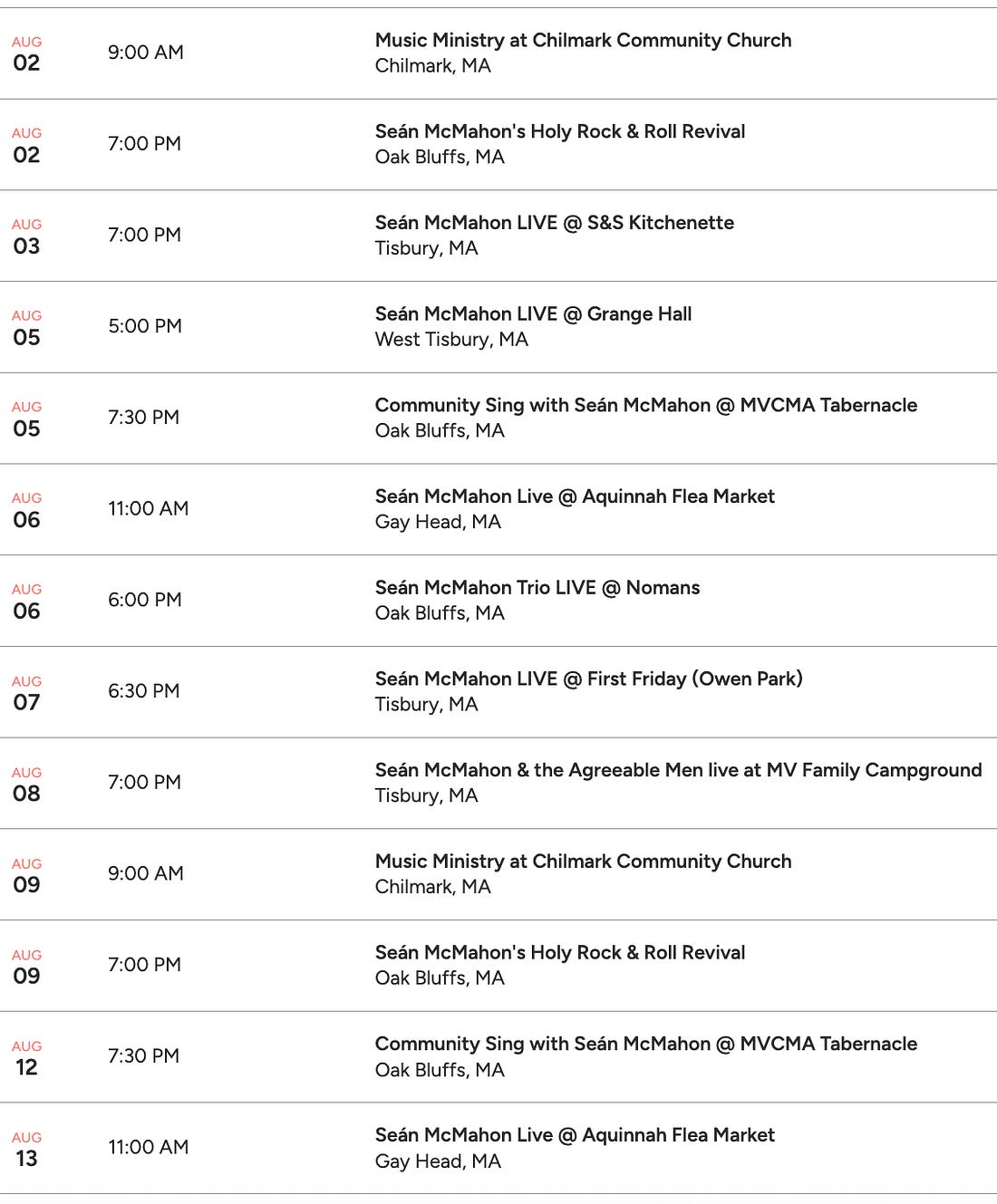
Song RequestsI’ll send you a personalized recording of your song request. Drop the song name in as a note along with your e-mail! Upcoming Events
You're currently a free subscriber to Seán McMahon. For the full experience, upgrade your subscription.
|





No comments:
Post a Comment