
Scripture ReadingRomans 9:1-8; 11:1-2, 29-32I speak the truth in Christ; I am not lying, as confirmed by my conscience in the Holy Spirit. I have deep sorrow and unceasing anguish in my heart. For I could wish that I myself were cursed and cut off from Christ for the sake of my brothers, my own flesh and blood, the people of Israel. Theirs is the adoption as sons; theirs the divine glory and the covenants; theirs the giving of the law, the temple worship, and the promises. Theirs are the patriarchs, and from them proceeds the human descent of Christ, who is God over all, forever worthy of praise! Amen. It is not as though God’s word has failed. For not all who are descended from Israel are Israel. Nor because they are Abraham’s descendants are they all his children. On the contrary, “Through Isaac your offspring will be reckoned.” So it is not the children of the flesh who are God’s children, but it is the children of the promise who are regarded as offspring…I ask, then, has God rejected his people? By no means! I myself am an Israelite, a descendant of Abraham, a member of the tribe of Benjamin. God has not rejected his people whom he foreknew. For the gifts and the calling of God are irrevocable. Just as you were once disobedient to God but have now received mercy because of their disobedience, so they have now been disobedient in order that, by the mercy shown to you, they too may now receive mercy. For God has imprisoned all in disobedience so that he may be merciful to all.Scripture ReflectionI’m a Jewish Christian, like St. Paul and all the rest of the twelve apostles. To be a Jewish Christian, particularly in 2026, is to carry a unique type of cross. My mother’s ancestors protected and sustained their Jewish identity for generations, and I’m the sorry schmuck who broke the mould. To be fair, the mould was already cracked, much like the Liberty Bell, in America. My Jewish forebears seem to have assimilated to American culture in the early-to-mid-20th century, leaving behind the passionate Hasidism of their Galitzianer culture. All I knew of Jewish culture pertained to food — Chinese food and bagels — and self-satirizing humor with the occasional crack at the “goyim.” I knew even less of Jewish religion, occasionally celebrating Passover with my cousins before they moved away when I was very young. I lost contact with the larger body of second and third Jewish cousins around the same time due to a schismatic family feud over a grandfather clock. In some ways, the family of Israel was in just such a state of schism by the time St. Paul wrote his 1st century Epistle to the Romans. Named after the blessed grandson of Abraham, Israel sojourned in Egypt and gathered around Moses in the wilderness, binding together in covenant with God by the laws he had received on Sinai. The nation’s existence was always precarious: her angelic constitutions (Acts 7:53) promised the children of Israel abundant life in times of fidelity, but disastrous national death in return for apostasy. As Jesus taught, Israel’s Law hanged on love of neighbor, which was the synonym for complete devotion to her God. Schism, then, was the form of covenantal infidelity which brought about Israel’s catastrophic waves of invasions and exiles. United they stood then divided they fell, until the twelve tribes of Israel had all been sundered from another, and only a remnant remained intact to inherit the traumatized homeland and embody the once-great family of Israel after half a century of exile in Babylon. Though this remnant was comprised of survivors and their children from the tribes of Levi, Benjamin, and Judah, they came to be known by the name of the latter: the Jews. The Jews’ return to the land was foretold by the prophets, even the timing thereof. But it would not be an easy road, nor would it would fully restore the Kingdom of God to Israel. Jerusalem and her temple, which was sacked by the Babylonians, would be restored under the occupation of the subsequent Medo-Persian regime; and the prophet Daniel foresaw that these two regimes were but the first two of four who would “trample down Jerusalem” (Lk. 21:24) and hold the reins of her divine Kingdom. The Kingdom of God had been taken from Israel for a time, and God would not anoint any Kings in her for many years. It was the Medo-Persian King Cyrus, not a Jew, who, according to Isaiah, was the Lord’s “anointed one” (Is. 45:1) in his mission of rebuilding Jerusalem. It was under his edicts, and for the greatness of his kingdom, that the Jews labored. But a time would come when once again a man of Israel would be anointed and the Kingdom restored to his people. The prophets said so. When I was a young adult, seeking to understand my Jewish roots, I spent time in Hillels and Chabads and learned of their hopeful expectation of the Messiah, and enjoyed Matisyahu’s songs that pined for his advent. But as my relationship with scripture deepened, I turned to the pages of Daniel the Prophet and saw that he foresaw the Messiah’s grand advent happening in the days of the fourth regime, half a millennium after the Babylonians first sacked Jerusalem. He said when it would happen. Half a millennium after the fall of Jerusalem to Babylon was two thousand years ago. When Jesus of Nazareth was born, wise men of the East followed not only the stars, but Hebrew oracles such as Daniel’s, seeking the promised Messiah of God in Jerusalem. When Jesus ministered in the region, he proclaimed that the Kingdom of God had finally drawn near as promised, and he challenged everyone to recognize in his works the identifying marks of the Messiah long foretold by the Prophets. Then as now, many rejected him; St. Paul did at first. Even Jesus’ closest disciples abandoned him when he was crucified by the Judean regime, which served at the pleasure of Rome — the fourth regime to rule over the region, following after Greece. Since he so challenged their Messianic expectations, not to mention their traditional worldview and sense of identity, Jesus was rejected by many Jews, whose descendants went on to build their Jewish identity without him. This is the Jewish identity I inherited, only a part of which consciously revolved around the rejection of Jesus. Nonetheless, from a young age, I understood that embrace of Jesus would seem to endanger my Jewish identity. For years, Jesus was never in the cards anyway: to me, he was either a fictitious figure or an exaggerated one. My chief beef was with his followers, simply because I thought they were cheesy not only to believe in a God, which I thought was unintelligent and naive, but one Incarnate at that, which I thought was ridiculous and stupid. My Jewish relatives perhaps shared these reasons for unbelief, as well as documented and very serious reasons for complaining to the Anti-Defamation League about their treatment at the hands of Christians. As I understood it, I was born a Jew in spite of the long history of Christian persecution of my people. To “join the Christians” would be an absurd and absolute betrayal of my people. This sense of betrayal echoed down to me from St. Paul’s day. Before his conversion, he was scandalized by Christians, too. They went about proclaiming that Israel’s hope for liberation and glory was a crucified man whom they preposterously claimed was alive; and they said that they were even liberated from the Law of Moses by this man, because the blood shed at his death was a new covenant that allowed them to transcend the old covenant’s legal conditions which had accursed their people to national death. They too, like Jesus, proclaimed the Kingdom of God, but its constitution was not the Law of Moses; it was Jesus himself. They didn’t go about like the Zealots did, chasing after Messianic figures who claimed they would save Jerusalem through force; they warned that the Lord, in fact, was soon going to fulfill his tearful warning to Jerusalem that “the days will come upon you when your enemies will barricade you and surround you and hem you in on every side. They will level you to the ground—you and the children within your walls. They will not leave one stone on another, because you did not recognize the time of your visitation from God…Behold, your [temple] is left to you desolate.” (Lk. 19:43-44, 13:35). These words came true within the generation. The Christians proclaimed that the Kingdom of God would no longer be exclusively local to the twelve tribes’ lands, nor exclusive to the twelve tribes themselves. The Kingdom of God would be everywhere, and her throne would not be in doomed Jerusalem: a New Jerusalem had come, a heavenly and eternal one, and they were her children (Gal. 4:26). They claimed to be in direct communion with their risen, heavenly Christ, and that he himself was, is, and forever shall be the Lord worshipped and seen by the most faithful of Israel’s prophets and patriarchs. The prized temple of Israel, they said, was not that in Jerusalem which was built by and soon to be torn down by the hands of men, but Christ, “in whom the fullness of the the Godhead dwells bodily” (Col. 2:9), and of whose mystical immortal body they claimed to be living members. It was utterly scandalous. As my Jewish grandparents’ generation dissolved their bonds battling over a grandfather clock, so did the 1st century generation of Jews that battled over the temple — whether the temple of stone or the temple of Christ’s body (Jn. 2:21). How I wish that my family had chosen the unity of the familial body over a perishable man-made construction. Jesus, as he wept over Jerusalem all those years ago, knew that many of his Jewish family too would choose a man-made object destined for destruction over the unity of their ancestral ties — that is, faith. And this is why Paul had such “deep sorrow and unceasing anguish” in his heart for his people. As the “Apostle to the Nations,” that is, the Gentiles, his divine mission was to welcome the world into the family of Abraham, patriarch of Israel. His former friends among the Jewish authorities insisted that this could only be done through obedience to the Law of Moses and by bearing the marks of Second Temple Judaism. That is, their view of things was that God’s chosen people were a legally constituted nation for Jews only, and any non-Jewish proselytes should become Jewish “children of Abraham” by adherence to the Law. Paul was at pains to explain to them and to all that Abraham lived long before Moses’ day, and neither he nor his children were expected to be under the Law in order to be considered God’s family. Nor was the Law Eden’s constitution. Christ had come to restore the universal unity of humanity that was purposed for Adam in the beginning, not to perpetuate the Law’s exclusivity. It was by the Law that Christ was put to death, and Paul extends this death sentence to all who are under it; but it was the Spirit who raised him from the dead, and Paul extends this glorious hope of resurrection to all. To those who receive this hope with faith, Paul gives the name “The Israel of God.” (Gal. 6:16). The Law, in other words, was never the true constitution of God’s family, but “a pedagogue to lead us to Christ that we might be justified by faith. Now that faith has come, we are no longer under a pedagogue.” Faith was always the true substance of the Law, and that by which God created his human family to be bound together: “You are all children of God through faith in Christ Jesus. For all of you who were baptized into Christ have clothed yourselves with Christ. There is neither Jew nor Greek, slave nor free, male nor female, for you are all one in Christ Jesus. And if you belong to Christ, then you are Abraham’s seed and heirs according to the promise.” (Gal. 3:24-29). Even more than revealing the virtue that comes from faith rather than works of the Law (Ro. 3:21), the Incarnation had destroyed the barriers between Jews and the rest of the world (Eph. 2:14). When I was young, I was taught that being Jewish made me different. I learned from various sources that I was one of God’s “chosen people.” I encountered various opinions on what that was supposed to mean: chosen to be a positive example, or chosen to be superior; chosen to serve, or chosen to rule. Paul explains in more lucid terms that they were chosen to be the stewards of God’s traditions not for their own glory, but for Christ’s, because it was from among them that Jesus Christ would arise and by his bearing of all the prophetic marks proclaimed to and preserved by them, he would be recognized by them first, then proclaimed by them to the world: “Theirs is the adoption as sons; theirs the divine glory and the covenants; theirs the giving of the law, the temple worship, and the promises. Theirs are the patriarchs, and from them proceeds the human descent of Christ, who is God over all, forever worthy of praise!” And this, it must not be forgotten, was all to fulfill God’s promise to Abraham that “through your seed,” Christ, “all nations shall be blessed.” When Paul says, “it is not as though God’s word has failed,” this is the word to which he is referring. The purpose of the chosen people was to bear the one who would be a blessing all humanity, and to anticipate this universal blessing by being such a blessing themselves. God’s purpose ultimately prevailed in the former mission, which was his own, while the latter challenge, the peoples’ mission, was often a failure — the story of all our lives! For Paul, “not all who are descended from” Israel or Abraham may be truly called Israel or Abraham’s children — for the lifeblood of this family is not DNA but faith in God’s promises fulfilled in Christ. And any from all nations may have this faith, and be called “Israel.” For “a man is not a Jew because he is one outwardly…No, a man is a Jew because he is one inwardly.” (Ro. 2:28-29). These words challenged my self-conception as a Jew when I first read them. But I was eager to understand what it truly meant to be Jewish, and by the time I was willing to read these words in the New Testament writings, I had begun to perceive that the promise God long ago asked my ancient ancestors to believe and preserve had been fulfilled in its forecasted time by and in Jesus Christ. I wanted more than just to be the inheritor of promises, laws, types and shadows: I wanted to step into the fulfillment of all that for which my people had longed and partake of it. I believed and was baptized. This conversion experience just about coincided with the very last of the years for which I would have been eligible to take a “birthright trip” to the land of Israel, of which I never availed myself during my Hillel and Chabad days. It was bittersweet timing. I had once mused about traveling to Israel and claiming my right of return citizenship, as I’d heard such wonderful things about Tel Aviv’s music scene from my Israeli musician friends. Now I was keen to see the places where Jesus lived, died, and rose again. But as a new Jewish convert to Christianity, I was now disqualified by Israeli law not only from my birthright trip but from any hope of easily claiming Israeli citizenship. Non-Jewish people might have better chances of attaining Israeli citizenship than me! The irony was so striking: my natural right to citizenship in the State of Israel had been eviscerated by my supernatural citizenship in the “Israel of God.” I have been sundered from the family of the former by my joining the family of the latter, a family which is open to all. I am blessed that my conversion to Christianity has not caused any major schisms on the Jewish side of my own family — assimilation and secularization have been gifts in that regard, speaking from a purely selfish standpoint. But I am thoroughly sympathetic to Paul’s sorrow and anguish for his people, for I often feel it myself. It is one thing for me to long to see all people know the mercy of God in Christ; it is another to have discovered what I sincerely believe to be the truth of my peculiar ethnic inheritance, and long to see my kin seize it and become its beneficiaries and champions. The Jewish tradition is a goldmine because it points to the ultimate treasure, the Kingdom of Heaven in Christ. But there is a sad difficulty in having inherited divine oracles which, if we do not recognize their timely fulfillment in Jesus, would seem to have been lame-duck. It’s an existential crisis, really, to be told that you are God’s peculiar people, and yet his promises to us have not quite been kept. If these stories are not true, then who are we? I’m half-Irish — the Irish don’t have to reckon with an origin story that claims God himself made us to be his chosen people to inherit the very Kingdom of Heaven. But this is the case with the Jewish people. With Paul I long, at the very least, for my people to know that the God of our origin story is real, has always been true, will ever be faithful, and his word never fails.
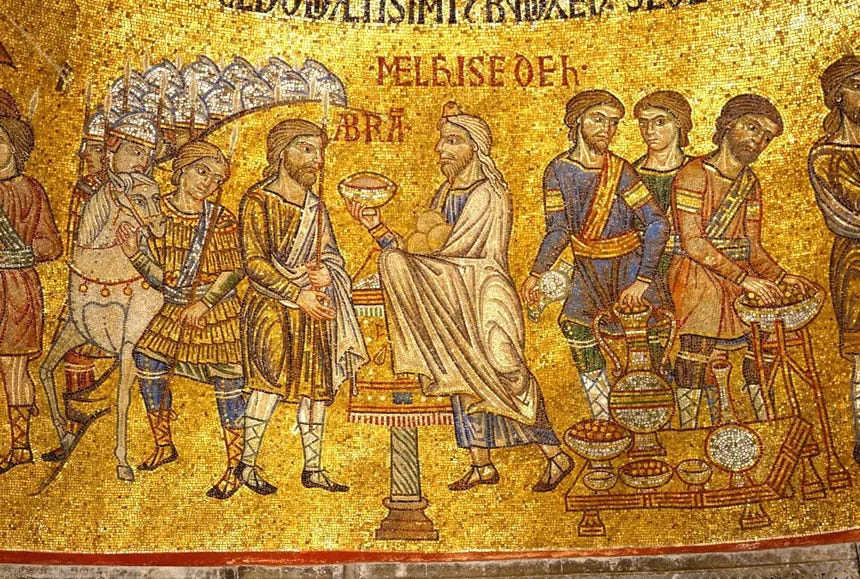
Abraham receiving the Eucharist and the blessing of Melchizedek.Song Meditation: “Table of Grace”
“Small Town Incorporated” is now available on VINYL! Order yours today
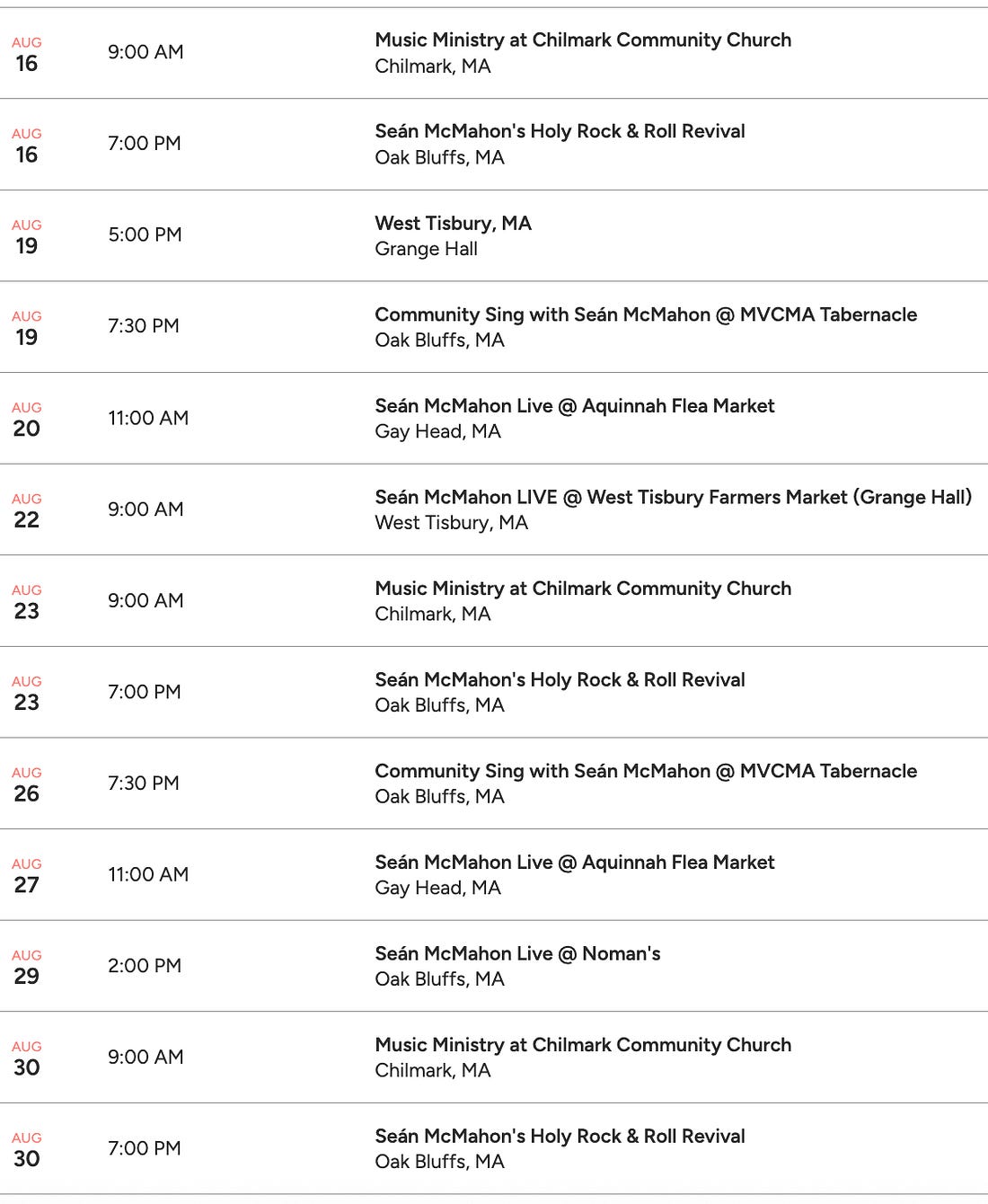
Song RequestsI’ll send you a personalized recording of your song request. Drop the song name or idea in as a note along with your e-mail! Upcoming Events:
You're currently a free subscriber to Seán McMahon. For the full experience, upgrade your subscription.
|







No comments:
Post a Comment