
Make Disciples of All NationsThe call to peace is simple Gospel arithmetic; it’s elementary teaching. It’s basic.
Scripture ReadingActs 2:14,36-41Peter, standing with the eleven, raised his voice and addressed the crowd, “Let the entire house of Israel know with certainty that God has made him both Lord and Messiah, this Jesus whom you crucified.”Now when they heard this, they were cut to the heart and said to Peter and to the other apostles, “Brothers, what should we do?” Peter said to them, “Repent, and be baptized every one of you in the name of Jesus Christ so that your sins may be forgiven; and you will receive the gift of the Holy Spirit. For the promise is for you, for your children, and for all who are far away, everyone whom the Lord our God calls to him.” And he testified with many other arguments and exhorted them, saying, “Save yourselves from this corrupt generation.” So those who welcomed his message were baptized, and that day about three thousand persons were added.Scripture ReflectionIn the days of the Exodus, a time came when Moses seemed to have abandoned his people. He had gone up to the summit of Mount Sinai and disappeared. He was gone for forty days and forty nights. But when the days had not yet been numbered, and his fate still seemed uncertain — if not sealed —, some gave up on Moses. They connivingly approached his brother Aaron and said, “Come, make us gods who will go before us. As for this Moses who brought us up out of the land of Egypt, we do not know what has happened to him!” (Ex. 32:1). The leaders of this insurrection confiscated all the gold the people had plundered from Egypt and gave it to Aaron, who melted it down into a golden calf, and they worshipped it as a god of Egypt. They had “turned back to Egypt in their hearts”. It was not uncommon for peoples of that culture to make themselves “great” by consolidating their nation’s wealth into a central place, whether a temple, or melted down into an idol. By these means, they could take the protection of their material well-being into their own hands, more easily defending it in one place from mauraders’ raids, which were common among desert people like them. Such an idol is rather heavy, after all — far heavier than golden trinkets that can be easily snatched from people’s tents. Such a paranoid enterprise is a far cry from our Lord’s faithful, and rather optimistic, charge: “do not worry about tomorrow, for tomorrow will worry about itself. Sufficient for today is its own trouble” (Mt. 6:34). Nor would he sanction the worship of money: “You cannot serve both God and mammon” (Mt. 6:24). When Moses descended from the holy mountain with the commandments of God only to find that the people for whom they had been prepared had already broken them, all hell broke loose. It was time to choose sides: the God of Israel, or the gods of Egypt; the slain lamb of the Passover which had saved them from wrath, or the golden calf of the wilderness which would drag them under it; trust in heavenly provision and holy sharing amongst God’s people, or fearful hoarding, and violent appropriation, of the people’s scarce resources. Sides were chosen; the royal priesthood which had once been promised to all the people (Ex. 19:5-6) was instead handed to the Levites as a reward for the slaughter of the rebels. All three thousand of them were slain in one day. Thousands of years later, a similar scene unfolded in Jerusalem. Jesus, the “prophet to come” foretold by Moses (Deut. 18:15-19), had been publicly executed by his own people in the name of the integrity of that great temple of consolidated wealth at the heart of their city, which, much to the chagrin of the nation’s most faithful priests and lovers of God (Ez. 3:12-13), had been built by pagan Babylonians and apostate Herodians. Though Christ had conquered death and arisen from the grave by this time, this fact was still a secret kept among his closest disciples. Jesus had designated his apostolic Church the new holy mountain (Heb. 12:22), Zion, and he was with them for forty days and forty nights (Ac. 1:3), just as Moses had been on Mount Sinai for forty days and forty nights. The time came for Jesus’ ascension to the right hand of God; he entered into the presence of the Ancient of Days, rising on a cloud into heaven, as foreseen long ago by the prophet Daniel (Dn. 7:13-14). He ordered his disciples to go to Jerusalem and await his coming in the Holy Spirit, by whom they would receive his law inscribed upon the tablets of their hearts (Jer. 31:33; Heb. 8:10; 1 Jn. 2:27). When the cloven tongues of spiritual flame came down to dwell in the apostles, their chief, Peter emerged and revealed to the pilgrims in Jerusalem the truth which had been concealed for forty days and forty nights: Jesus is not dead, he is alive; he has risen and has been given the divine name above all names; Jesus is LORD-and-Christ. And with this proclamation, Peter laid the charge for the Christ’s death at their feet, even as Moses laid Israel’s guilt at their feet in the wilderness of Sinai: “Let the entire house of Israel know with certainty that God has made him both Lord and Messiah, this Jesus whom you crucified.” In a stunning recapitulation of Israel’s first days in the wilderness, when her priesthood was born by the blood of three thousand slain, we are told that on the day of Pentecost, three thousand were slain in the spirit — baptized into the death and resurrection of Jesus, and added to the number of believers, that royal priesthood of Christ after the order of Melchizedek (Heb. 5:9-10): “a chosen people, a royal priesthood, a holy nation, God’s special possession, that you may declare the praises of him who called you out of darkness into his wonderful light” (1 Pt. 2:9). As in one day a nation was born in the wilderness by the blood of three thousand slain in the flesh, so also on the one day of Pentecost, the nation of Israel was reborn, its kingdom restored to God by its King (Ac. 1:6-8), by the spiritual “slaughter” of three thousand slain in the waters of baptism. For as by baptism, we are buried into Christ’s death (Ro. 6:3-4; Col. 2:12), so indeed these three thousand truly “died” that day to their “corrupt generation”, and were raised to a new life of grace in the Christian community, the Kingdom of God. The recent, very public clash between the worldly powers today and the successor of St. Peter, Pope Leo XIV, is a vivid recapitulation of this timeless scene of Pentecost for today’s “corrupt generation”. Embodied in his words alone, the Pope’s prophetic ministry as a peacemaker — his is the same peacemaking ministry handed to all Christians — fell on deaf ears with nearly all the world powers called to task by his call to peace. Shall we too take it personally, take offense, when we are exhorted to peace? When the charge of the blood of Christ, who lives among the poor and the meek, is laid at our feet? Do we align with “this corrupt generation” or with the eternal Holy Spirit? Is it not the divine right of the Holy Spirit to speak through his people, and call his “governing authorities,” his “deacons...avengers of wrath to the wrongdoer”, to protect and serve the justice which it is their duty to protect and serve (Ro. 13:1-4)? “For there is no authority except that which is from God. The authorities that exist have been appointed by God” (Ro. 13:1) — therefore the Spirit of God has every right to speak into the ministries of those ministers whom he appoints, whether in Church or in State. According to Romans 13, God does not separate the two as we do. The call to peace is simple Gospel arithmetic; it’s elementary teaching. It’s basic. For this same reason, the post-Pentecost growth of the Church was spearheaded by prophetic confrontations between the Kingdom of God and the Empire of Satan. Sts. Peter, James, John and Stephen confronted and preached God’s grace in Christ to the Sanhedrin, the Supreme Court of the Jewish people, and all the high priests of the Temple establishment. James and Stephen almost immediately paid for this with their blood, and received their crowns of martyrdom. St. Peter first opened the Kingdom of God to the nations by preaching to a Roman centurion, a military man, and he was eventually crucified upside down once he had brought his Gospel to the authorities in Rome. St. Paul alone preached to almost all the governing authorities between Jerusalem and Rome: he preached to Porcius Festus, prefect of Judea, successor to Pontius Pilate, who tried Christ; and to Herod Agrippa II, whose predecessor Herod Antipas also tried Christ. He preached to the governor of Judea, the proconsuls of Cyprus and Achaia, the magistrates and jailers of Philippi, the politarchs of Thessalonica and Ephesus, and even the cultural leaders in the council of Areopagus. Christian tradition holds that finally, Paul preached to Emperor Nero as the angel had foretold (Ac. 27:24) — even returning from the dead to preach to Nero yet again even after the Emperor had beheaded him (Ac. Paul 10/14). The 1st century disciples of Christ, under his direct spiritual tutelage (1 Jn. 2:27), went about proclaiming the social Kingship of Christ in earnest because the law of the Spirit inscribed in their hearts proclaims “Jesus is Lord”. They didn’t go into this struggle armed with swords of steel, engaging prelates, princes, and emperors in bloody battle; they went armed with the sword of the Holy Spirit to fight the War of the Lamb. Theirs was a “regime change” operation achieved not by conventional warfare, changing the face of the polis by substituting one leader for another; but by spiritual warfare, changing the mind of the polis with captivating argumentation for the Gospel (2 Cor. 10:3-5), and substituting Christ’s tender sacred heart of flesh for their former hearts of stone. By these means, not only were “hearts of stone” changed in individuals; but whole societies exchanged their cultic “hearts of stone” — their temples which held all their wealth and glory, as the Golden Calf and the Herodian Temple once did in Israel — for “hearts of flesh” — temples of the Holy Spirit comprised of flesh and blood people dedicated to the renewal of all Creation by God’s grace working through their faithful love. At such a violent and mortal cost to themselves, why did the saintly evangelists of the early church, “recovering sinners” like you and me, do all of this? They reasoned amongst themselves that the promise to Abraham had at last been filled; the time had come for God to gather together and adopt all the numberless peoples of the nations, alienated from one another and scattered by sin with its endlessly evolving social structures, to be his beloved, and loving, children. The 1st century saints reasoned that the time of Israel’s rebirth had finally come; this time, they found themselves not at the foot of Sinai, “a mountain that can be touched and that is burning with fire; to darkness, gloom, and storm; to a trumpet blast or to a voice that made its hearers beg that no further word be spoken” (Heb. 12:18-19), but they had come to the summit of Mount Zion, “the city of the living God, the heavenly Jerusalem…to myriads of angels in joyful assembly, to the congregation of the firstborn, enrolled in heaven…to God the Judge of all, to the spirits of the righteous made perfect, to Jesus the mediator of a new covenant.” (Heb. 12:22-24). And so, in fulfillment of these promises, and at the commandment of Our Lord Jesus Christ, they committed to making “disciples of all nations, baptizing them in the name of the Father and of the Son and of the Holy Spirit” (Mt. 28:19). May all our nations also be likewise discipled, baptized, and reborn in Christ, in accordance with his promise and command, beginning with us — after the manner of those first three thousand cut to the heart and slain in the spirit on Pentecost by the word of God out of the mouth of St. Peter. Amen.
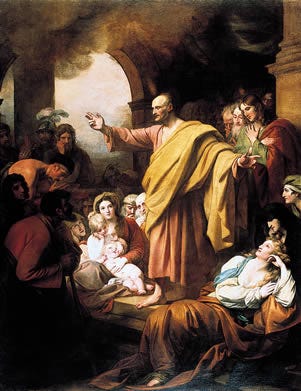
Benjamin West, “St. Peter Preaching at Pentecost”Song Meditation: “All Hail King Jesus Christ”
|




Hymns and Homilies, by Seán McMahon Seán McMahon |
“All Hail King Jesus Christ”
This past Holy Week I found myself inspired, writing and recording companion songs for the journey from the Triumphal Entry to the Resurrection. You can find all these brand new songs here:
All Hail King Jesus Christ, by Seán McMahon Seán McMahon |
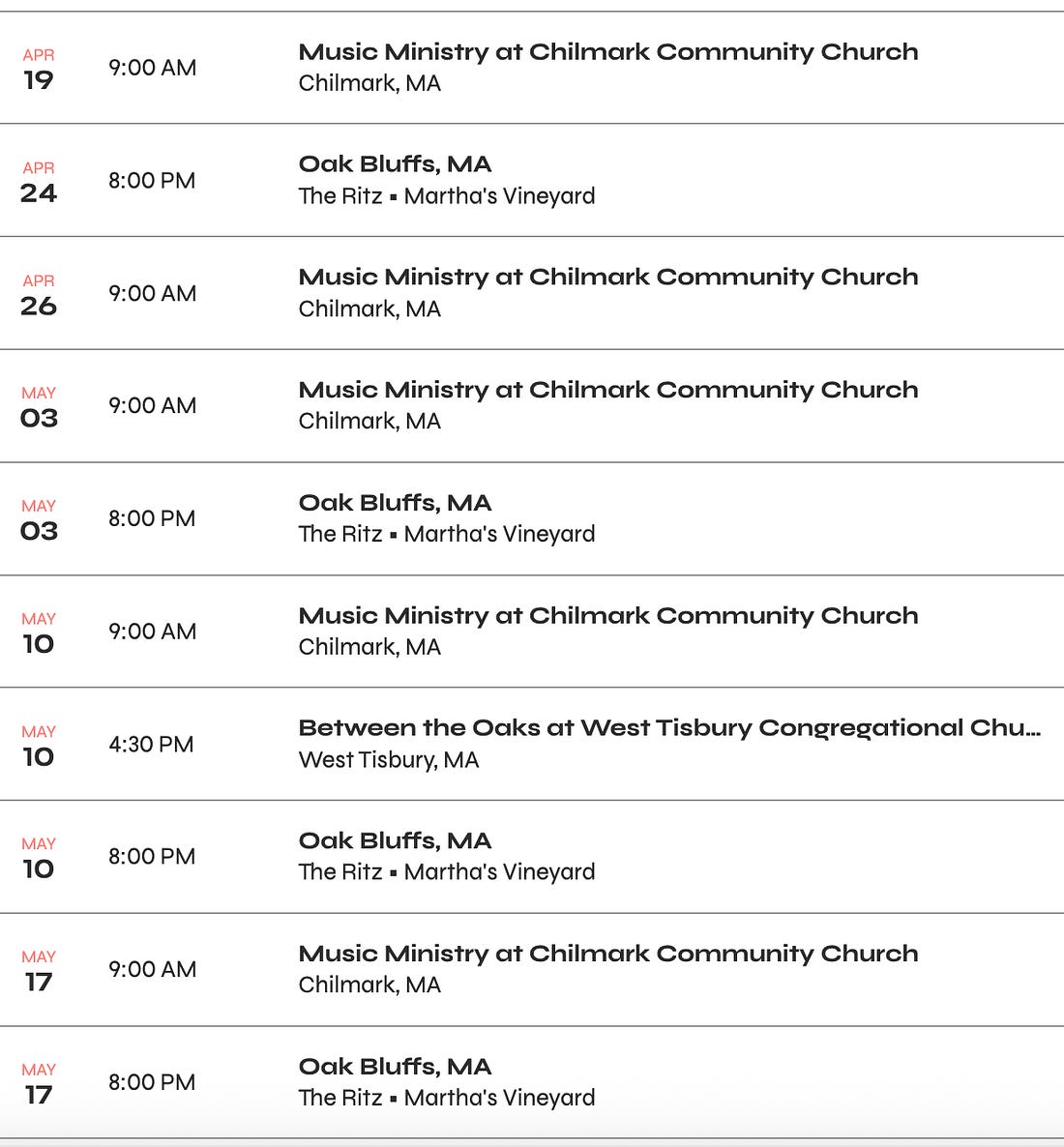
Upcoming Appearances:
 |
You're currently a free subscriber to Seán McMahon. For the full experience, upgrade your subscription.
|
||||||||||


No comments:
Post a Comment