
Vicarious Atonement & SolidarityYou’ve heard it said before that Jesus died in our place. But what if we live in Jesus’ place?
Scripture ReadingMatthew 10:40-42Jesus said, “Whoever welcomes you welcomes me, and whoever welcomes me welcomes the one who sent me. Whoever welcomes a prophet in the name of a prophet will receive a prophet’s reward; and whoever welcomes a righteous person in the name of a righteous person will receive the reward of the righteous; and whoever gives even a cup of cold water to one of these little ones in the name of a disciple-- truly I tell you, none of these will lose their reward.”Scripture ReflectionYou’ve heard it said before that Jesus died in our place. This doctrine is called vicarious atonement. But I say today, what if we live in Jesus’ place? In fact, that’s precisely what he has called us to do. When you were baptized into the name of Christ, you took his name. More than that, St. Paul speaks of our “putting on” Christ like a garment. Even more than that, he speaks of Christ living his life through us, and us living Christ’s life rather than our own. This is what I mean by living in Jesus’ place. In theology, it is common to speak of “vicarious atonement” in terms of Christ dying in our place to shield us from wrath and secure the bounty of grace — and this for the sake of the whole world, since “God so loved the world that he gave his Son.” (Jn. 3:16) Since this atonement pertains to the whole world, or cosmos (1 Jn. 2:2), it is therefore worth exploring its cosmic dimension. Scripture reveals that the Cross was an act of divine justice; but we should not envision the scales of justice with Jesus on one plate and the people of the world on the other. In fact, opposite the plate of the enemy’s accusations and condemnation, we are weighed together with Jesus, since on the Cross, he drew every man to himself (Jn. 12:32). And together, we are justified, not found wanting. It is not that Jesus “took our place” in substitution so much as he took his place among us in solidarity, sanctifying us with his divine presence. His Passion reveals precisely the nature of holiness in that God willed his Son’s total devotion to humanity — that is, solidarity — unto death. We are called to follow this example. The voice that beckons us to solidarity is the Holy Spirit; the Spirit empowers us to live it out; the Spirit suffuses and seals the living community of solidarity, the “communion of the saints”. Though the Cross reveals that this communion is invisibly universal, it is made visible in the fruits it bears, and those who bear fruit together for the sake of this divinely-ordained solidarity are called the “Church”, which is comprised of “Christians” — little Christs. We “little Christs” are called to imitate our eldest brother Jesus Christ (Heb. 2:11), even in his work of “vicarious atonement”. To act vicariously is not to be a substitute. No one can substitute for Christ. To act vicariously is to be a vicar; to be, as St. Paul called us, ambassadors of Christ and ministers of the reconciliation (2 Cor. 5:18-20) of which his life, death, and resurrection are the ultimate testimony. The radical solidarity Jesus offers to the world is such that one may regard a work of mercy as being a gift that is both given as well as received by Christ himself. “Whoever welcomes you welcomes me, and whoever welcomes me welcomes the one who sent me...‘Truly I tell you, whatever you did for one of the least of these brothers of Mine, you did for Me.’” (Mt. 10:40, 25:4). This is vicarious atonement in action, where benefactor and beneficiary are both vicars of Christ. The life of charity, in fact, is lived to the end that this truth might become manifest to those from whom it is hidden. The mystery of vicarious atonement is not exhausted by what Christ has done for us, but is completed in what he now longs to do through us. By living in his place — bearing his name, wearing his mercy like a garment, and living his life in solidarity with the least and the lost — we become vicars of the reconciling Divine Love that triumphed on the Cross. Every cup of cold water given, every stranger welcomed, every act of mercy offered in his name is another echo of that cosmic welcome by which God drew together all humanity in Christ. May we therefore go forth not merely as beneficiaries of his grace, but as his benefactors — his vicars in the world: little Christs who make visible the invisible communion, revealing the face of the One who sent him in every welcome given and received. Amen.
Song Meditation: “Table of Grace”
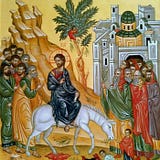
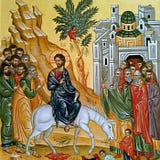
Inspiration has struck!This Holy Week I found myself writing and recording companion songs for the journey, from the Triumphal Entry to the Resurrection. You can find all these brand new songs here:
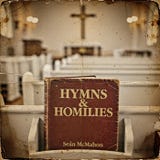
ICYMI: New Album “Hymns & Homilies” Out NowI invite you to download and listen to my album, out now: “Hymns & Homilies” — an eclectic collection of songs for worship and musical sermons. This is not your grandaddy’s Christian music. Name your price — your support for my work of music ministry is a blessing!
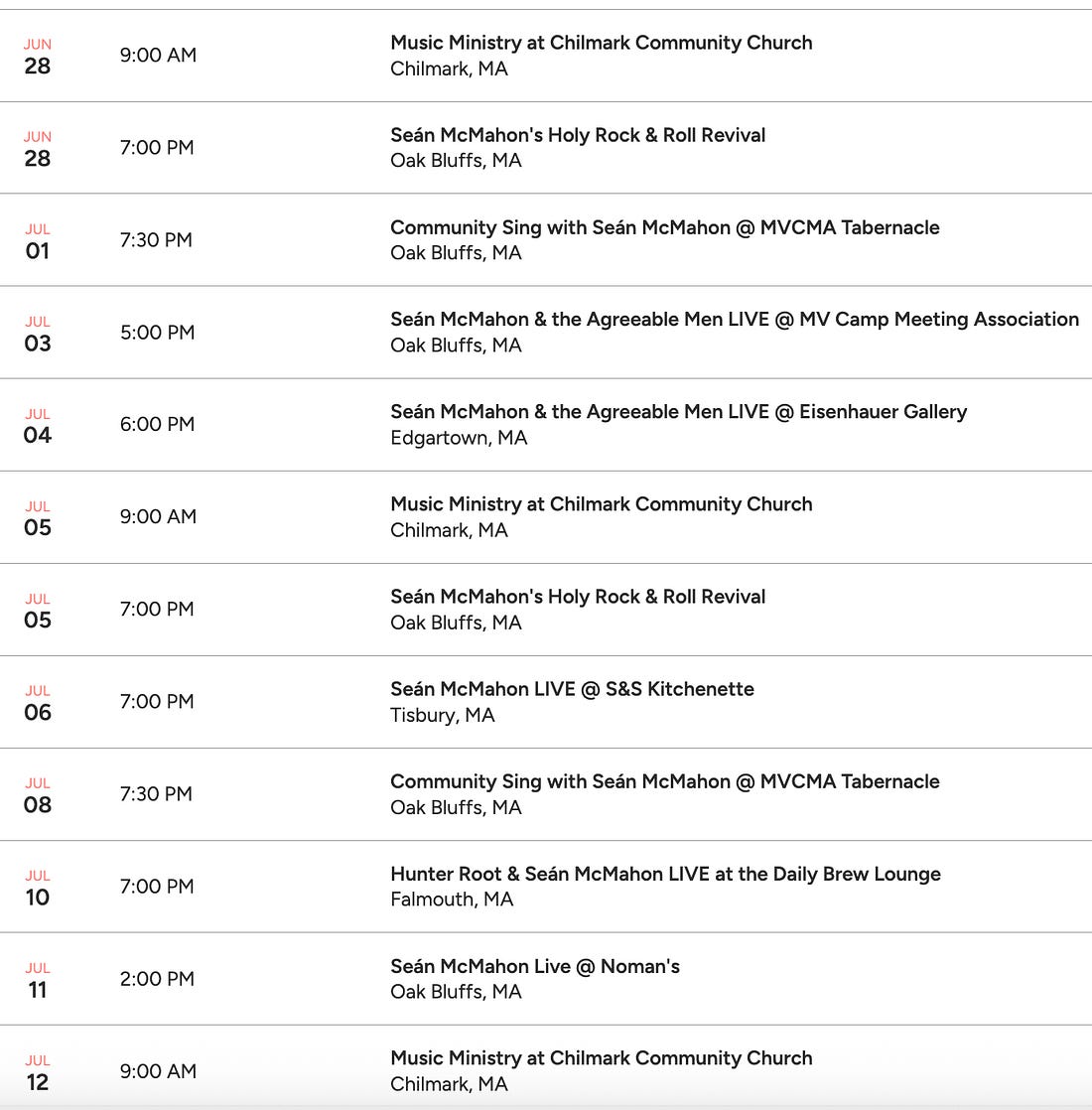
Upcoming Appearances:
You're currently a free subscriber to Seán McMahon. For the full experience, upgrade your subscription.
|







No comments:
Post a Comment