Today’s Scripture ReadingsGenesis 12:1-4 The Lord said to Abram, “Go from your country and your kindred and your father’s house to the land that I will show you. I will make of you a great nation, and I will bless you, and make your name great, so that you will be a blessing. I will bless those who bless you, and the one who curses you I will curse; and in you all the families of the earth shall be blessed.” So Abram departed, as the LORD had directed him, and Lot went with him Romans 4:1-5, 13-17 What then are we to say was gained by Abraham, our ancestor according to the flesh? For if Abraham was justified by works, he has something to boast about, but not before God. For what does the scripture say? “Abraham believed God, and it was reckoned to him as righteousness.” Now to one who works, wages are not reckoned as a gift but as something due. But to one who without works trusts him who justifies the ungodly, such faith is reckoned as righteousness. For the promise that he would inherit the world did not come to Abraham or to his descendants through the law but through the righteousness of faith. If it is the adherents of the law who are to be the heirs, faith is null and the promise is void. For the law brings wrath; but where there is no law, neither is there violation. For this reason it depends on faith, in order that the promise may rest on grace and be guaranteed to all his descendants, not only to the adherents of the law but also to those who share the faith of Abraham (for he is the father of all of us, as it is written, “I have made you the father of many nations”) — in the presence of the God in whom he believed, who gives life to the dead and calls into existence the things that do not exist. John 3:1-17 There was a Pharisee named Nicodemus, a leader of the Jews. He came to Jesus by night and said to him, “Rabbi, we know that you are a teacher who has come from God; for no one can do these signs that you do apart from the presence of God.” Jesus answered him, “Very truly, I tell you, no one can see the kingdom of God without being born from above.” Nicodemus said to him, “How can anyone be born after having grown old? Can one enter a second time into the mother’s womb and be born?” Jesus answered, “Very truly, I tell you, no one can enter the kingdom of God without being born of water and Spirit. What is born of the flesh is flesh, and what is born of the Spirit is spirit. Do not be astonished that I said to you, ‘You must be born from above.’ The wind blows where it chooses, and you hear the sound of it, but you do not know where it comes from or where it goes. So it is with everyone who is born of the Spirit.” Nicodemus said to him, “How can these things be?” Jesus answered him, “Are you a teacher of Israel, and yet you do not understand these things? “Very truly, I tell you, we speak of what we know and testify to what we have seen; yet you do not receive our testimony. If I have told you about earthly things and you do not believe, how can you believe if I tell you about heavenly things? No one has ascended into heaven except the one who descended from heaven, the Son of Man. And just as Moses lifted up the serpent in the wilderness, so must the Son of Man be lifted up, that whoever believes in him may have eternal life. “For God so loved the world that he gave his only Son, so that everyone who believes in him may not perish but may have eternal life. “Indeed, God did not send the Son into the world to condemn the world, but in order that the world might be saved through him.”
Scripture ReflectionThe Kingdom of God that Jesus came proclaiming is the nation promised long ago to Abraham. It is a Kingdom of faith and hope, and it belongs to those who believe and hope in it. Though that might make it sound like John Lennon’s vision of Nutopia, an imaginary country which only exists in the minds of those who imagine it, nonetheless, the Kingdom of God is very real, and its existence is not contingent on the faith of its faithful or the hope of its hopeful. For many didn’t believe Christ when he came to proclaim it. No matter. He is the one who first came to proclaim it because he is its King, and the Kingdom is in him. Where he is, there the Kingdom is. Many of those who heard Jesus’ good news about the Kingdom struggled to believe it. They were the descendants of the recently returned exiles of Judea. Their ancestors had once lived in a Kingdom known for its great wealth, wealth both of gold and spirit. David reigned over Israel and his son Solomon raised up its gold-wealth and temple. The Kingdom splintered: rebellions and occupations in the balkanized north and south of the former Kingdom. The prophets went into hiding and the nobles were carried off to serve their conquerors. Nearly a century later, some of those from Judea were allowed to return, rebuild Jerusalem and her temple. These, according to the 1st century Jewish historian Josephus, were the ones who came to be known to history as “the Jews”. They were but a remnant of once-great Israel. Many of them longed for the restoration of the Kingdom to all of Israel, promised by their prophets. The Maccabean revolt reached for this, but failed. Their alliance with the Romans against Greece became an unholy marriage which the 1st century Christians would come to interpret as the final of Daniel’s four beasts (Dn. 7), whom the Messiah would emerge from heaven to defeat, and at last restore the Kingdom to Israel. Surely Nicodemus was motivated by such hopes when he risked his reputation for a private audience with Jesus of Nazareth. He wanted to know about the Kingdom of God from Jesus — he might have suspected, or hoped, that this Galilean “teacher…from God”, who went about proclaiming the Kingdom of God, might be the promised Redeemer. But where was his sword, his army, their military camps? Perhaps Nicodemus had discerned that this violent type of Redeemer was not what God had in store for Israel. Jesus had come proclaiming the Kingdom of God not with the flags of war, but with “signs…from the presence of God.” Nicodemus was ready to learn from Jesus about the Kingdom of God, which his soul longed to see. But: “No one can see the Kingdom of God without being born from above,” said Jesus. Jesus was repeating himself. Nicodemus finally had Jesus in private — and here Jesus was just teaching the same thing he taught the masses. He openly taught that the Kingdom cannot simply be seen: “The kingdom of God does not come with observable signs. Nor will people say, ‘Look, here it is,’ or ‘There it is.’” (Lk. 17:20-21). He openly taught that God himself cannot be seen except by one who is already in heaven: “not that anyone has seen the Father except the One who is from God; only He has seen the Father.” (Jn. 6:46). And how can one be “born from above” except first by ascent? Yet Jesus says, “No one has ascended into heaven except the one who descended from heaven, the Son of Man.” And this statement raises even more disturbing problems. If the Kingdom can only be seen by such a person who has ascended and descended, born from above, and that person is the Son of Man alone, then what does this say about the Kingdom in the days of David and Solomon — neither of whom were the Son of Man — except that it was never the promised Kingdom for which Abraham and the prophets longed, and which Jesus had come to proclaim? Paul in his letter to the Romans says plainly that the Kingdom and nation which he here calls the “world to come” was never a promise given to Abraham or his descendants through the Mosaic Law upon which David’s Kingdom was founded. That is, the reward for obedience to Moses was never the Kingdom of God. As a teacher of the Law who perhaps looked for the Kingdom of God as the goal of the Law, Nicodemus might have found this devastating. He was certainly shocked by Jesus’ exposition of this doctrine: “no one can enter the Kingdom of God without being born of water and spirit. What is born of flesh is flesh, and what is born of spirit is spirit.” That is, neither one born into the tribe of Judea, nor one born into any of the other tribes of Israel, inherit anything of the Kingdom of God by virtue of being descendants of Abraham, Isaac, or Jacob. To enter the Kingdom, they would have to give up this “birth” for another. If blood descent from Abraham, to whom this promise was given, accounts for nothing, how much less so obedience to the Law of Moses, which came later, and didn’t carry the Abrahamic promise. But, according to Paul, the promise depends on faith. And faith is a gift of the Spirit (1 Cor. 12:9), who, like the wind, “blows where it will” according to Jesus. To enter the Kingdom of God, one must be born of this Spirit, and water, which is a Hebraicism for heaven, owing to Genesis 1’s illustration of heaven as the “waters above”. One who would be “born from above” must then become a partaker in the sole ascending and descending Son of Man, and this is precisely what Jesus promises with the gift of the Spirit: “I will ask the Father, and he will give you another advocate to help you and be with you forever—the Spirit of truth…he lives with you and will be in you…On that day you will realize that I am in my Father, and you are in me, and I am in you…we will come to [you] and make our home with [you].” (Jn. 14:16-20, 23). This promise is contingent on a new command: “Abide in me, and I will abide in you…abide in My love. If you keep My commandments, you will abide in My love, just as I have kept My Father’s commandments and remain in His love.” (Jn. 15:4, 9-10). This is the “royal law” (Ja. 2:8) which holds that promise which Moses’ Law did not. The Law of Moses only “brings wrath,” according to Paul (Ro. 4:15). But the promise of the Law of Christ is the Holy Spirit, the divine life of the Lord himself — to those who are diligent in their faith to Christ’s word. These, partakers in Christ who is the true seed of Abraham and heir of the promise given to him (Gal. 3:16), receive the promise with him: “I will make of you a great nation, and I will bless you, and make your name great, so that you will be a blessing. I will bless those who bless you, and the one who curses you I will curse; and in you all the families of the earth shall be blessed.” And yet, this promise was so far off for Nicodemus, himself under the Law of Moses, and being warned of such seemingly impossible conditions to fulfill: being born again, ascending and descending to heaven, etc. The way to the Kingdom of eternal life would not be open to him, or to anyone, until the Great Judgment, whose verdict Jesus freely declares to Nicodemus: “the Son of Man must be lifted up, that whoever believes in him may have eternal life. For God so loved the world that he gave his only Son, so that everyone who believes in him may not perish but may have eternal life. Indeed, God did not send the Son into the world to condemn the world, but in order that the world might be saved through him.” This is the Good News. How unbelievable it would seem that the exaltation of the Christ, the champion and revealer of the Kingdom of God, would not be a glorious coronation of the likes enjoyed by David and Solomon, but a horrific execution, of a type accursed by the Law, being hanged by impalement upon a tree (Deut. 21:23). The Kings of Israel and Judah would reign and execute judgment from their thrones in Jerusalem; Christ would judge the world from the Cross: “‘Now judgment is upon this world; now the prince of this world will be cast out. And I, when I am lifted up from the earth, will draw everyone to Myself.’ [Jesus] said this to indicate the kind of death He was going to die.” (Jn. 12:31-32). And so, as Moses lifted up the accursed serpent upon the pole in the days of the Exodus, so the world lifted up Jesus, who was accursed by the type of death he was to die; and as the Hebrews looked upon the serpent and were healed, so the world may look upon the Crucified Christ and see God’s final judgment revealed: not condemnation, but salvation. And the way of salvation is open to us through the Cross, through which Jesus conquered death and rose again by the power of the Spirit “who gives life to the dead and calls into existence the things that do not not yet exist” (Ro. 4:17). For “the flesh profits nothing” (Jn. 6:63), but has its end in death; there is nothing spiritual to be gained from any end to which we may devote our flesh, since the flesh has only one end — it is delusional to think otherwise. In other words, “that which is born of flesh is flesh”. But “that which is born of spirit is spirit” — and this is our faith and hope, that through Christ who gives us the promised Spirit, we may live a spiritual life, sowing spirit from spirit into spirit, that nothing may be lost and everything may be gained. “All who have this hope in [Jesus] purify themselves” (1 Jn. 3:3), and such, born from above, are the blessed and pure of heart who see God (Mt. 5:8) and His Kingdom (Jn. 3:3). Amen.
Song Meditation: “Eden”
If indeed you are listening, why don’t you raise your hand? Show me what you’re feeling. Show me how you feel. I’m drowning in this country trying to get to the Promised Land. For I am offering water as we stand on this scorching sand. And I wanna find my brothers, and gather all my sisters. For we were dead on arrival, awaiting a calling voice or a hand. Well, if you would be the living, then you would let go your life. And listen to its voice. Pass along its song. I ain’t alone in this aching darkness. I’m staying warm in your light. If indeed you are listening, why don’t you raise your hand? Show me what you’re feeling. Show me how you feel. I’m drowning in this country trying to get to the Promised Land. I am waiting in a station for the train to take me home. And my friends, you’re all beside me. And I want to take you with me. The engine’s getting louder, so it must be time for us to go. So let us head home back to Eden. Forward is the way. And if we carry all the wounded, and stay pure as little children, then we will get through this night of darkness and be home by the break of day. ICYMI: New Album “Hymns & Homilies” Out NowI invite you to download and listen to my album, out today: “Hymns & Homilies” — an eclectic collection of songs for worship and musical sermons. This is not your grandaddy’s Christian music. Name your price — your support for my work of music ministry is a blessing!
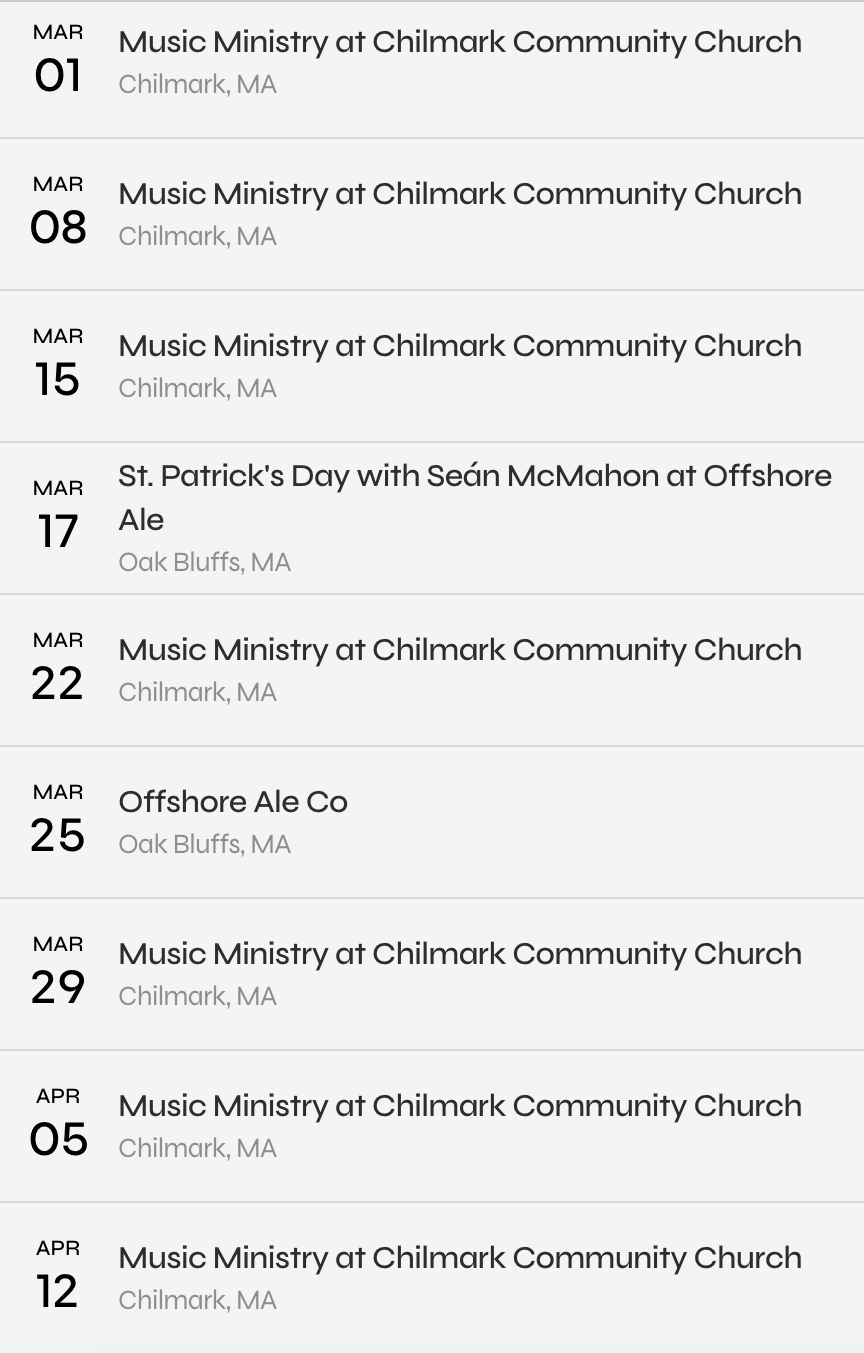
Upcoming Appearances:
You're currently a free subscriber to Seán McMahon. For the full experience, upgrade your subscription.
|
Sunday, March 1, 2026
Seeing the Kingdom: Sunday Scripture Reflection






Subscribe to:
Post Comments (Atom)
No comments:
Post a Comment