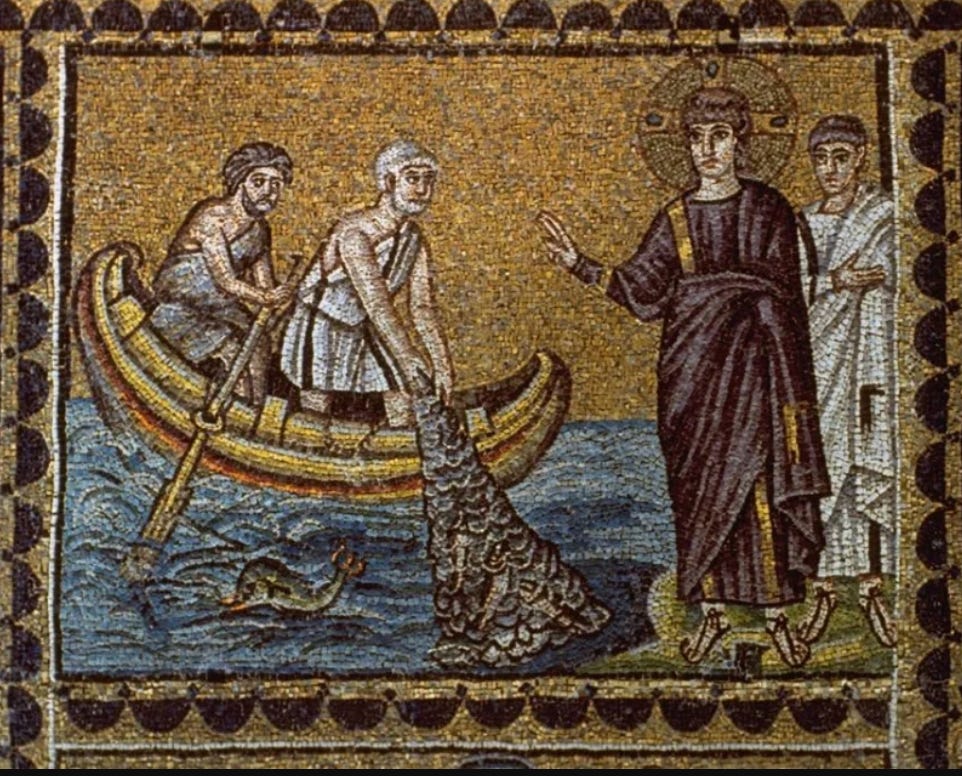
Today’s Scripture ReadingsPsalm 27:1, 5 The Lord is my light and my salvation; One thing have I asked of the Lord; 1 Corinthians 1:11-14 It has been reported to me by Chloe’s people that there are quarrels among you, my brothers and sisters. What I mean is that each of you says, “I belong to Paul,” or “I belong to Apollos,” or “I belong to Peter,” or “I belong to Christ.” Has Christ been divided? Was Paul crucified for you? Or were you baptized in the name of Paul? Matthew 4:12-19 When Jesus heard that John had been arrested, he withdrew to Galilee. He left Nazareth and made his home in Capernaum by the sea, in the territory of Zebulun and Naphtali, so that what had been spoken through the prophet Isaiah might be fulfilled: “Land of Zebulun, land of Naphtali, the people who sat in darkness and for those who sat in the region and shadow of death From that time Jesus began to proclaim, “Repent, for the kingdom of heaven has come near.” As he walked by the Sea of Galilee, he saw two brothers, Simon, who is called Peter, and Andrew his brother, casting a net into the sea—for they were fishermen. And he said to them, “Follow me, and I will make you fishers of men.” Scripture ReflectionAmong the first called of Jesus’ disciples were fishermen, the brothers Simon Peter and Andrew. He called them out of the sea and said that henceforth, they would be fishers of men. This is cleverly quaint language, but it contains great mysteries. The sea is found in the bookends of the Bible, Genesis and Revelation, and it is very important. It has a great power and an important destiny. In Genesis, the seas emerge from the division of the waters from the dry land, which were the waters below which had been separate from those above. Before this, all the waters were undivided primordial waters; and they were called “the deep,” or the “abyss,” תְה֑וֹם. It was this “deep” that was there in the very beginning of Genesis 1, and the Spirit of God was moving on its face. And so the seas are the earthly division of this mysterious, primordial abyss. That is their beginning. According to the book of Revelation, their end is to be “no more” (Rev. 21:1). Between these two Biblical bookends, the prophets use “the sea” synonymously with “the abyss” — it is the place of darkness and death. When Jesus calls his disciples out of the sea, he is calling them out of the deep, the abyss of darkness. When he says they are to be fishers of men, he means that they are to be, like him, a light that rescues others from that darkness. Hence, “the people who [sit] in darkness...in the region of shadow and death” are the people of the sea for whom the disciples in Christ are to cast their nets. The net is the Word of God; and John tells us in the prologue to his Gospel that this Word is life, and the light of all men. He tells us that “The Light shines in the darkness, but the darkness has not overcome it” (Jn. 1:5). Genesis tells us that light was divided from darkness in the beginning, but in the midst of the darkness, our Creator draped the luminaries: the sun, the moon, the stars. John saw a vision of this: a woman clothed with this very sun, standing on this very moon, and crowned with these very stars (Rev. 12:1), and she gave birth to the divine King — the Word of God, the life and light of men. God, in his goodness, did not create a darkness so dark that it was devoid of light; and this vision shows that the darkness, clothed in the heavenly luminaries, even gave birth to the light of lights, our divine King. The Christ was born, “veiled in flesh” as the old Christmas carol sings, but even the veil of the flesh could not hide his light. “The people who sat in darkness have seen a great light” — the light of Christ. Seeing that the light shines in the darkness and the darkness cannot overcome it, we must see to it that we do not exaggerate for ourselves the division between light and darkness. As Paul taught in 1st Thessalonians 5, whether we are awake in the light of spiritual life, or asleep in the darkness of spiritual death (such are the “outsiders” in 1 Thess. 4:12), Christ died for us all so that we may live together with him. If we ought to not exaggerate the division between the “children of light” and the “children of darkness” — Christians and non-Christians — how much more so shall we look upon our fellow travelers in the faith with magnanimity and inclusiveness. But today as in Paul’s day, “there are quarrels among [us].” As in his day, when some said, “I belong to Paul,” or “I belong to Apollos,” or “I belong to Peter,” or “I belong to Christ,” so also today there are many denominations to whom many Christians say they belong — and they might say so in a spirit of fierce competition. Seeing Paul’s struggles with this in his own times, we can take comfort that this is nothing new under the sun. But we should hear him when he questions this type of factionalism under the light of Christ, the run of righteousness: “Has Christ been divided?” Of course not. For everything that exists, exists in, through, and for him (Col. 1:27). He is all and in all (Col. 3:11). If all things in heaven and earth are reconciled together in him (Col. 1:20), even the primordial poles of light and darkness as we have seen, how silly it is to presume that the body of Christ is divided on the basis of the trifles of Christian factionalism. “Was Paul crucified for you?” Of course not. Neither was Peter, nor any of his successors, the Popes; neither was Luther, Calvin, Zwingli, Wesley, etc. “Or were you baptized in the name of Paul?” No — we Christians were baptized in the name of Jesus, if not in the name of the whole Trinity, Father, Son, and Holy Spirit. The Church, which is the body of Christ (Eph. 1:22-23), cannot truly be divided, since Christ cannot be divided. It is truly universal in the most cosmic sense, since the undivided Christ indeed is all and in all. The Church’s universality has, from her earliest days, been expressed with the word “Catholic”. We see the beginnings of this in Acts 9:23, where the young Church at that time, though spread across the very different territories and demographics of Judea and Galilee, is described as “kath’holēs”. Today, the Church is spread across even more diverse territories and demographics, and many a teacher and student has wrestled with scripture and tradition to understand, and put into words, the divine mysteries revealed in the Gospel. We bend the knee to the Tower of Babel in defeat if we should claim that this multiplicity of words, and various theological languages, somehow has the power to undo the unity purchased for us by the revelation of Christ in the Gospel. In truth, the curse of Babel was long ago lifted by Our Lord. St. Ignatius of Antioch, contemporary and disciple of the apostles, wisely wrote, “Wherever Jesus Christ is, there is the Catholic Church.” And, as we have seen so clearly proclaimed in the scriptures, Jesus Christ is all and in all — he, as the Word of God, is the Knowledge of the glory of the Lord (since Knowledge is always shared by Word) which “fills the earth as the water covers the sea” (Hab. 2:14). The light of the Word of Life is that great Light which may be seen by all who, like fish, sit in primordial sea of darkness. And as this great sea of darkness is now illuminated by that great light which it could not overcome, we may truly declare and celebrate with Rev. 21’s words that “the sea is no more” indeed, because the darkness of death has been swallowed by the victory of Christ’s luminous life (1 Cor. 15:54, 2 Cor. 5:4). Since all creation is swimming in and with Christ our Light, there is no longer the problem of darkness, but of blindness: “the god of this world has blinded the minds of the unbelievers, to keep them from seeing the light of the gospel of the glory of Christ.” (2 Cor. 4:4). But “when one turns to the Lord, the veil is removed” (2 Cor. 3:16) that “the eyes of your heart may be enlightened in order that [we] may know the hope to which he has called [us], the riches of his glorious inheritance in his holy people, and his incomparably great power for us who believe.” (Eph. 1:18-19). “How can they believe in the one of whom they have not heard? And how can they hear without someone preaching to them?” (Ro. 10:14). Hence, the faithful are entrusted with the ministry of reconciliation, to declare all these things. To make this declaration is to be a a fisher of men: a messenger of Christ, his herald of the Good News.
Song Meditation: |


Revival, by Seán McMahon Seán McMahon |


How can I be satisfied if I don't have the love of the Lord in my heart? Therefore my soul magnifies the Lord, and this little prayer is all I've got. People never ask you no more how goes your walk of faith, nowadays the world I walk is just not that kind of place But I know redemption is at hand. I feel the rumbling of the stones awakening all across the land. Revival, oh revival! The devil is on the left and the devil is on the right, now ain't that right? But I'm just facing forward toward the source of all the love and the light. People don't you ever wonder how it was we lost our way? Maybe this world we built was built to break. But I know redemption is at hand. I feel the rumbling of the stones awakening all across the land. Revival, oh revival! Flock to the shepherd he will shepherd the flock. Give up what you are and give up what you got. Turn around leave it all behind and don't look back, ‘cause once you have nothing then nothing you will lack. Walk down the road and knock on the door. The Lord has need of you and you need the Lord. The saints are assembled they await you there. Enter the kingdom and receive your share.
ICYMI: “Whether We’re Awake Or Asleep”
“Whether We’re Awake or Asleep” is a musical meditation on 1st Thessalonians 4:13-5:11 — Christ’s reconciling love for all beings which encourages us toward faithful unity and mutual understanding. This is another experiment in melodic hip hop sermonizing inspired by Tobe Nwigwe and Father Dave Swantek, the rapping Catholic priest.
Whether We're Awake or Asleep, by Seán McMahon Seán McMahon |

ICYMI: “You”
“You” is a rap about self-discovery, soul retrieval, and theosis in the spiritual life of Christian mysticism. I’m been a huge fan of Beck for years, so I suppose it is inevitable that I would try my hand at rap. My Christian rap was inspired by two artists I recently discovered, Tobe Nwigwe and Father Dave Swantek, the rapping Catholic priest.
You, by Seán McMahon Seán McMahon |

You're currently a free subscriber to Seán McMahon. For the full experience, upgrade your subscription.
| ||||||||||


No comments:
Post a Comment