The Palms of Judgment DayTo wave your palms today is to reject the impoverished worldly wisdom which waits in hopeless fear for a Judgment Day after our own image, and instead to hail the Divine Wisdom...
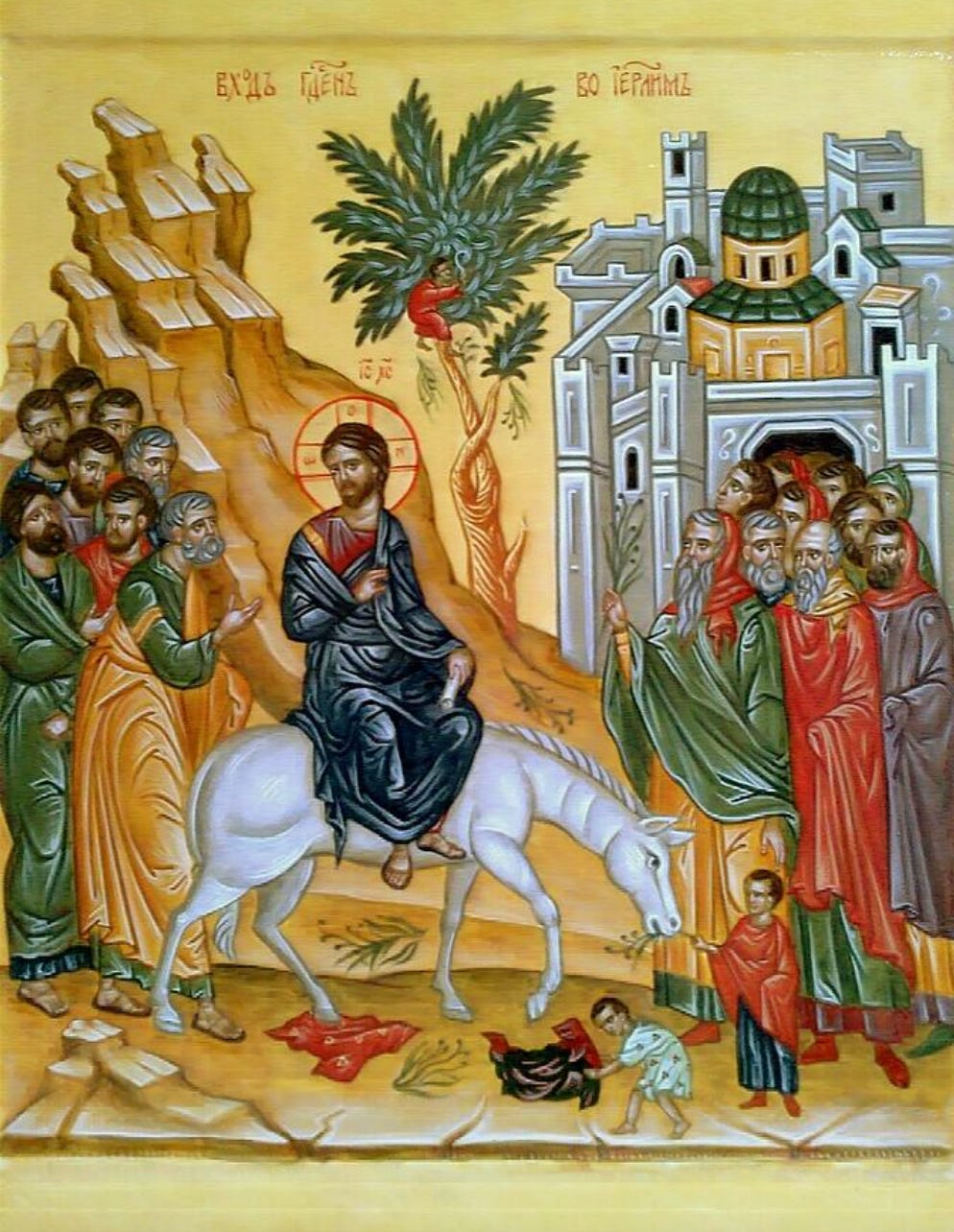
Today’s Scripture ReadingMt. 21:1-11 As they approached Jerusalem and came to Bethphage on the Mount of Olives, Jesus sent out two disciples, saying to them, “Go into the village ahead of you, and at once you will find a donkey tied there, with her colt beside her. Untie them and bring them to Me. If anyone questions you, tell him that the Lord needs them, and he will send them right away.” This took place to fulfill what was spoken through the prophet: “Say to the Daughter of Zion, ‘See, your King comes to you, gentle and riding on a donkey, on a colt, the foal of a donkey.’” So the disciples went and did as Jesus had directed them. They brought the donkey and the colt and laid their cloaks on them, and Jesus sat on them. A massive crowd spread their cloaks on the road, while others cut branches from the trees and spread them on the road. The crowds that went ahead of Him and those that followed were shouting: “Hosanna to the Son of David!” “Blessed is He who comes in the name of the Lord!” “Hosanna in the highest!” When Jesus had entered Jerusalem, the whole city was stirred and asked, “Who is this?” The crowds replied, “This is Jesus, the prophet from Nazareth in Galilee.” Scripture ReflectionDuring the reign of Darius I, late 6th century B.C., a priest arose in Achaemenid Jerusalem named Zechariah. The Wisdom of God spoke through him, and he prophesied that soon, a new temple would be built in the holy city. And his prophecy soon came true. The temple was commissioned by King Cyrus, whom Isaiah had called the Anointed One, or Christ (Is. 45:1). But Zechariah’s prophecy went further, and it might have seemed to many of the exiles returning to Jerusalem at that time that Zechariah had been a false prophet: Zechariah had said that the Lord himself would descend from heaven, and judge the whole world. It would be a unique day known as “the Day of the Lord,” when the Lord’s feet would touch down on the Mount of Olives, and he would lead his holy ones in Jerusalem to begin the Great Judgment. This would be the Great Jubilee, the end of the exile. Judgment Day. This didn’t happen during the reign of King Cyrus. The wise prophet Daniel understood this prophetic problem. He had been greatly disappointed that his people had not repented after seventy years of exile, as his predecessor Jeremiah had warned that they should. An angel visited Daniel and explained to him that, because God’s people had not repented, their seventy years of exile would be multiplied by seven. The wise generations who cherished the words of Daniel — and not all among the tribes of Israel were wise, or cherished the words of the prophets — patiently endured oppression for nearly five centuries, until the birth of Jesus, who began his ministry proclaiming himself as the long-awaited Anointed One (Christ), and the bringer of the Great Jubilee: “The Spirit of the Lord is on Me, because He has anointed Me to preach good news to the poor. He has sent Me to proclaim liberty to the captives and recovery of sight to the blind, to release the oppressed, to proclaim the year of the Lord’s favor.” (Lk. 4:18-19). In the final week of his Jubilee ministry, Our Lord’s feet indeed touch down on the Mount of Olives, and he descends into Jerusalem with his holy ones — his disciples and apostles. He rides in regally, but humbly, upon a donkey, fulfilling Zechariah’s great Day of the Lord prophecy. The Bible tells us so: “This took place to fulfill what was spoken through the prophet” (Mt. 21:4). Jesus is weeping over the city as he approaches her, because, after his years ministering to Jerusalem, she has failed to recognize her “hour of visitation” from the Lord (Lk. 19:44). However, Jesus does have a wise remnant who recognizes him as the Lord, and they are waiting for him as he rides into Jerusalem. They meet him waving palms, symbols of Wisdom, in the manner prescribed for the Feast of Tabernacles (Lev. 23:40) — even though it was the week of the Passover Feast — hailing Jesus as the Tabernacle of God among men. Ezekiel had foreseen the Messianic temple of the Last Day decorated with palms (Ez. 40-41) — and here Jesus, in whom the fullness of God dwells bodily (Col. 2:9) as in a temple, is decorated with the people’s palms. They not only exalt God’s Wisdom with their symbolic palms, but they exalt the Holy Wisdom with their words of praise: “Hosanna,” which means “save us”. “To the Son of David,” showing they knew he was the promised Christ who had come to save his people. “Blessed is he who comes in the Name of the Lord,” showing that they recognized Jesus as the exalted one given the Name above all Names (Php. 2:9). As the bearer of the Divine Name, Jesus is Wisdom incarnate, the real substance for whom the palms were only symbols. More than this, these wise people in Jerusalem, invoking Ps. 118:26f with its words of blessing for the one who comes in the name of the Lord, are signaling that they recognize that the Lord is coming to make atonement for the land with his imminent self-sacrifice, for the Psalmist also sang, “bind the festal sacrifice with branches” (v27). Hence, palm branches. Surely intimations of Jesus’ fate as a “festal sacrifice” were in the air: John the Baptist had openly declared Jesus the sacrificial Lamb of God at the beginning of his ministry; the high priest Caiaphas had prophesied that one man should die for the nation that year; and rumors were swirling around about grave danger for the Nazarene preacher. Jesus, the Lamb of God, enters the place of sacrifice, the temple. He begins to overturn the tables, driving out the moneychangers and even the sacrificial animals. He declares the place desolate and calls it a “den of thieves” (Mt. 23:38, 12:13)— the first Christians would later call it the Harlot of Babylon (Rev. 17:5), built as it was by the decree of Cyrus. He declares his own body to be the true temple: “Destroy this temple, and in three days I will raise it up again.” (Jn. 2:19). He is referencing Daniel’s prophecy that the temple would somehow be both destroyed and perfected in the last days (Dn. 9:24-27). Jesus wastes no time, and he minces no words. He loudly proclaims, “Now is judgment upon this world! Now is the ruler of this world cast out!” (Jn. 12:31). Is it not abundantly clear from his words, and the spectacle of his Triumphal Entry, that this is the Day of Judgment long ago seen by Zechariah in his vision? And yet, the climax of Jesus’ proclamation is a mystery, which only the wise would understand: “I, when I am lifted up, will draw all men to myself.” His wise apostle, John, understood that he was speaking about his death on the cross (Jn. 12:32-33). In other words, the Great Judgment was the Cross. It is safe to say that even now those who have ears and hear him say this, just like many who had eyes and saw it unfold back then, fail to understand what is being revealed. Some come forth waving palms of recognition, signs of Wisdom and understanding — but not all understand. Thousands of years later, Christians nervously watch the news, scanning for signs in the Middle East that this long-delayed (so they suppose) Day of Judgment is finally here. Long after Daniel’s timeframe closed. Long after Zechariah’s signs were seen, heard, and recorded in the Gospels. A Christian who searches for “The End” in this way might not realize that this mindset is an ironic denial of the Bible’s testimony that Jesus fulfilled everything written of the Christ (Lk. 22:44-47). It brushes aside the Biblical witness, filled with the evangelists’ constant winks at the reader: “Jesus did this to fulfill the prophecy!” Rather than waving palms of faith and Wisdom, such a person is wringing his hands in fear and ignorance — the sort of desperation for which Christian faith is meant to be the ultimate salve. There are equal parts trauma and miseducation at work when a Christian compulsively looks for the ultimate disaster, the war to end all wars, the crashing down of the falling sky, that signals his own idea of a gruesome “Judgment Day”, which is often just a projection of his own greatest fears about the chaos lying in wait just beyond, or even hiding inside, the fragile order upon which his world rests. It may even be a projection of one’s own self-loathing, remaking the world in the image of one’s own sense of wretchedness, threatening to torture and destroy it as if that were its undeniable due. This is tragic, and not at all the vision of humanity, or God’s love, that Jesus gave his life to give us. So much so-called “apocalypticism” is a mockery of God’s grace, a vulgar caricature of a God who, rather than purifying the world with the spiritual fire of love, one day says “never mind” to the Cross and incinerates the world with literal fire for destruction. This “apocalypticism” is unworthy of the word apocalypse, which means revelation — it does not reveal God, but aggressively obscures him, and veils him in that all-too-familiar egregore of archontic violence under which far too many are spellbound. Jesus, on the true Day of Judgment, did not project negativity onto humanity, nor did he exalt himself to be the destroyer of an unworthy world; he emptied himself. He poured out his glorious soul upon us so that we may be filled with what we are lacking. He was wounded to heal our wounds. He delivered to us, once and for all, the Gospel and ministry of reconciliation, in stark contrast to the power-hungry marching orders of the fallen cosmos’ rulers (Mt. 20:25f). Jesus was lifted up on the Cross, not a throne, and from Calvary he judged all humanity — and he drew us to himself to be crucified with him and to reign in merciful judgment alongside him. His is the example which we are called to follow, the image of God which we are to restore in ourselves through hope — “Christ in you, the hope of glory” (Col. 1:27); “All who have this hope in [Christ] purify themselves, just as [Christ] is pure.” (1 Jn. 3:3). Christ did not destroy the world in judgment; having judged it unclean, he took the mess upon himself, and cleansed the world by atonement. Believe it or not, we are called to do the same; that through us, the Church, “the manifold Wisdom of God might now be made known to the rulers and authorities in the heavenly places” (Eph. 3:10). This is the Church’s mission for every generation, in every age — to reveal “the exceeding riches” of this Wisdom, our heavenly Father’s “grace in his kindness toward us through Christ Jesus” (Eph. 2:7). This Gospel of Grace is the verdict and sentence rendered from the foundation of the world (Jn. 3:16-19; Rev. 13:8), when all was ordered by Divine Wisdom (Prov. 3:19). Our God is so gracious! Let us pray for Wisdom to adorn us with her beauty and grace (Prov. 4:9), even as Jesus was adorned by the palms of Wisdom at his triumphal entry, when the Lord’s feet touched down on the Mount of Olives and he descended into Jerusalem with his holy ones for the Glorious Day of Judgment. To wave your palms today is to reject the impoverished worldly wisdom which waits in hopeless fear for a Judgment Day after our own image, and instead to hail the Divine Wisdom, the Image of God, descending from the heights with tears of compassion, and proclaiming in the midst of this our holy city (for by his blood he cleansed the city of this world and made it his own) that Great and Glorious Final Judgment passed at the Old Rugged Cross.
Song Meditation: “All Hail King Jesus Christ”
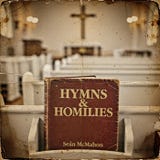
(lyrics by Seán McMahon, to the tune of “Ghost Riders in the Sky” by Stan Jones)Rejoice, O Jerusalem, your King approaches nearThe time has come to end the rule of death and the reign of fearNo prowling Lion e’er again shall gnash his teeth at theeBehold the Lamb of God rides in for love’s true victoryYippy-eye oh, Yippy-eye aye!All Hail King Jesus ChristIn the beginning, He split darkness from the lightAnd now, the daughters of the day from the sons of the night!Riding in humility, by truth He conquers all —Whether goats or sheep, whether great or smallYippy-eye oh, Yippy-eye aye!All Hail King Jesus ChristBut what sort of conqueror rides in with a white flag?What sort of rider rides in on a humble ass?Surrendering to enemies, and suffering to deathServing another’s sentence, paying another’s debts?Yippy-eye oh, Yippy-eye aye!All Hail King Jesus ChristWhat could we ever add to Him, simply waving palms?For He meets us in our need, with His words of healing balmHe didn’t come for His own glory, but to save, and to serveSo that all receive His healing, follow Him, and learnYippy-eye oh, Yippy-eye aye!All Hail King Jesus ChristICYMI: New Album “Hymns & Homilies” Out NowI invite you to download and listen to my album, out now: “Hymns & Homilies” — an eclectic collection of songs for worship and musical sermons. This is not your grandaddy’s Christian music. Name your price — your support for my work of music ministry is a blessing!
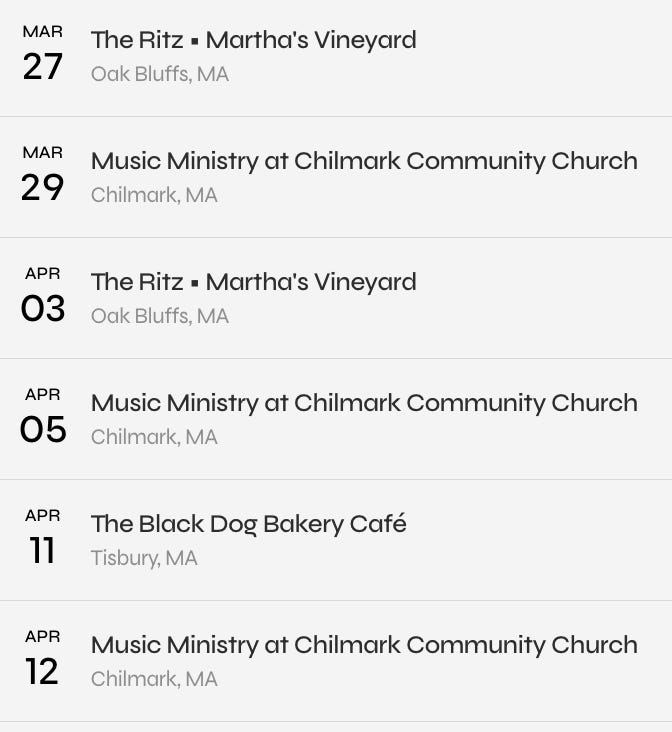
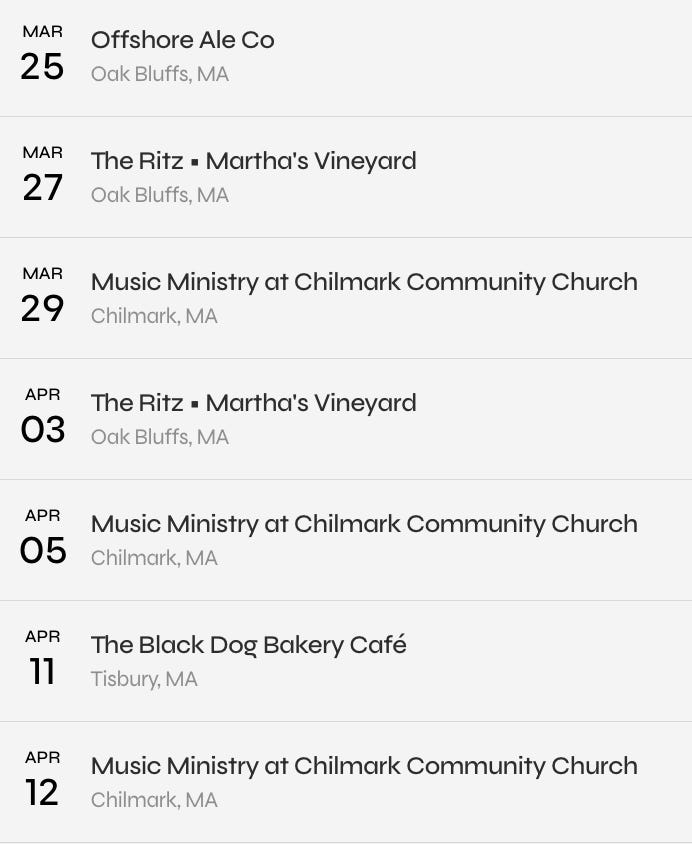
Upcoming Appearances:
You're currently a free subscriber to Seán McMahon. For the full experience, upgrade your subscription.
|
Sunday, March 29, 2026
The Palms of Judgment Day






Friday, March 27, 2026
All Hail King Jesus Christ | Palm Sunday Song
Hey all, today’s “New Music Friday” offering is public! It’s a “Christianese” cover of Stan Jones’ “Ghost Riders in the Sky” adapted for church use with Palm Sunday lyrics. I actually penned it back in 2024, but only got around to a studio version this week. It’s got a funky blend of Middle Eastern and spaghetti western vibes. Enjoy!
ICYMI: New Album “Hymns & Homilies” Out NowI invite you to download and listen to my album, out now: “Hymns & Homilies” — an eclectic collection of songs for worship and musical sermons. This is not your grandaddy’s Christian music. Name your price — your support for my work of music ministry is a blessing!
Upcoming Appearances:
You're currently a free subscriber to Seán McMahon. For the full experience, upgrade your subscription.
|